Notation and glossary
Definitions, 238 cited classical theorems from standard human literature, and annotated bibliography.
1Glossary
- Adeles
- A compatible list of local entries, one in each completion of a number field, integral at all but finitely many finite places. The diagonal embedding sends one field element to its value in every completion. Read in context
- Almost everywhere
- A property holds almost everywhere if the set where it fails has measure zero. Two functions in L² can differ on such a set and still represent the same vector. Read in context
- Analytic continuation
- An extension agreeing with a given analytic function on its original domain. Agreement on an open subset determines the continuation on a connected domain. Read in context
- Annihilator in a character group
- The characters of a finite abelian group that are identically one on a specified subgroup. Subgroup averaging selects exactly these characters. Read in context
- Annihilator in a ring
- For t in a commutative ring, Ann(t) is the ideal of all x with tx = 0. In a ring containing η with η² = 0, this ideal can contain η itself. Read in context
- Augmentation of the face complex
- The homomorphism from integer combinations of vertices to the integers that sends each vertex to one. Its kernel consists of the zero-dimensional cycles that the edges must fill. Read in context
- Automorphic function
- A function on an adelic group that descends under its rational subgroup and satisfies the prescribed regularity and other conditions. Square-integrability on the quotient matters for the lifts here. Read in context
- Bar chain
- A finite linear combination of ordered words in a group. Its boundary takes alternating faces obtained by omitting an end entry or multiplying neighboring entries. Read in context
- Bernoulli value of a character
- A weighted finite sum of Bernoulli polynomial values at fractions of the conductor. The minus estimate clears its denominators and uses the same algebraic integer at every coefficient prime. Read in context
- Bockstein map
- In the coefficient sequence for reduction modulo q, lift a cycle to an integral chain. Its boundary is a multiple of q. Dividing that boundary by q gives a class one degree lower, killed by q. This map distinguishes the two torsion orders in the cycle count. Read in context
- Character / χ
- A homomorphism from a finite group to nonzero complex numbers. A Dirichlet character extends by zero off the units modulo N. Read in context
- Class group / Cl(K)
- Fractional ideals of the number field K modulo principal fractional ideals. The quotient Cl(K)/ℓCl(K) measures the number of independent characters of order ℓ. Read in context
- CM field
- A number field that is a totally imaginary quadratic extension of a totally real field. Complex conjugation interchanges the two embeddings over any real place of the base. Read in context
- Cocycle
- A function c satisfying c(gh)=c(g)+g·c(h). Its class in degree one identifies functions differing by g↦g·a−a. Local conditions impose restrictions on these classes. Read in context
- Cocycle test on a prism
- A linear functional that vanishes on boundaries. For the residue test, consecutive pairs contribute carries and the last entry contributes an additive index. Read in context
- Coincidence point
- For two maps with a common source and target, a point of the source at which their values agree. For the identity map paired with a self-map, these are the fixed points of the self-map. Read in context
- Coinvariants
- Given an operator g on a module M, the quotient M/(g−1)M identifies each element with its translate under g. The quotient by gᵈ−1 maps onto it because gᵈ−1 is divisible by g−1. Read in context
- Conductor / f
- The least divisor of the modulus from which a Dirichlet character is induced. A primitive character has conductor equal to its modulus. Read in context
- Covolume
- The volume of a fundamental parallelepiped of a lattice in its real span with the chosen metric. Read in context
- Covolume of a lattice
- The volume of one fundamental parallelepiped, measured in the chosen ambient coordinates. In the complex plane the lattice generated by α and iα has covolume |α|². Read in context
- Critical strip / σ
- The region 0 < Re s < 1. Here s = σ+it; σ = ½ is the critical line. Read in context
- Cyclotomic layer
- A stage in a tower formed by adjoining roots of unity. In the ℓ-adic tower here, layer m has relative degree ℓᵐ over the chosen base field. Read in context
- Discrete valuation ring
- A ring in which each nonzero element has the form uπⁿ for a unit u, a fixed uniformizer π and a nonnegative integer n. This exponent measures divisibility. For ℤℓ one can take π=ℓ. Read in context
- Double coset
- For subgroups Γ and K of a group, the double coset of h consists of the products γhk with γ in Γ and k in K. Grouping an integral by these classes preserves the measure of each class. Read in context
- Doubling integral
- An integral obtained by placing two copies of a unitary group in a larger group and pairing a section there with matrix coefficients on the original copies. Its local factors determine the partial L-function in the theta norm. Read in context
- Eisenstein polynomial
- A monic polynomial whose nonleading coefficients belong to the maximal ideal of the coefficient valuation ring and whose constant coefficient belongs to the first power of that ideal but not its square. In the period construction its image generates the kernel of Fontaine’s map. Read in context
- Elementary divisors
- A pair of full local lattices can be put into diagonal form by integral changes of bases. The integer exponents of a uniformizer classify their relative position. Their sum gives the determinant valuation and the sum of their absolute values gives the degree in the split-place series. Read in context
- Euler’s constant / γ
- The limit of 1+1/2+⋯+1/n − log n; it is the constant Laurent coefficient of ζ at 1. Read in context
- Field norm and ideal norm
- In a Galois extension the field norm multiplies all conjugates of an element. The ideal norm sends a prime above a base prime to the power of the base prime given by the relative residue degree. For a principal ideal these two constructions agree. Read in context
- Formal degree
- The positive constant in Schur orthogonality for a discrete series and a chosen Haar measure. For a unit vector v it satisfies ∫|⟨v,σ(g)v⟩|² dg = 1/dσ. Read in context
- Formal group and formal logarithm
- A group law in power series at the identity and a change of coordinate taking that law to addition. Read in context
- Frame height
- In the symmetric normalization the two integral Frobenius matrices multiply to the Eisenstein polynomial raised to twice the height, times the identity. The height also sets the scalar in the Frobenius equation for the period basis. Read in context
- Frame of a regular Gram fibre
- An ordered list of independent vectors whose matrix of mutual Hermitian pairings is nonsingular. Its length can be smaller than the ambient dimension. Read in context
- Frobenius and inertia
- Inertia is the subgroup of a local Galois group acting trivially on the residue field. A Frobenius class acts there by raising to the residue-field size. Read in context
- Generalized eigenspace
- For an operator T and a scalar λ, this is the space of vectors killed by some power of T − λ. Its dimension counts the whole nilpotent chain at λ, including vectors that are not eigenvectors. Read in context
- Genus mass
- For a positive definite lattice, sum 1/|Aut(L)| over one representative of each isometry class in its genus. A weighted average of a count divides the corresponding weighted sum by this mass. Read in context
- Genus of a Hermitian lattice
- The full lattices in a fixed rational Hermitian space that are isometric to a given lattice at every finite place. A genus may contain several global isometry classes. Read in context
- Gram matrix
- The matrix of pairwise inner products of a list of vectors. Its diagonal records squared lengths. If the vectors are columns of M in orthonormal coordinates, the Gram matrix is M* M. Read in context
- Haar measure
- A translation-invariant measure on a locally compact group. Its normalization matters when comparing the two sides of the Petersson identity. Read in context
- Hecke operator
- An operator formed by summing translates indexed by the cosets in a double coset. The operator in the invariant-period comparison divides by the number of cosets, so it fixes constants. Read in context
- Homology and cohomology
- A cycle is a chain with zero boundary, and its homology class records it up to addition of boundaries. A cohomology class tests cycles by a cocycle, which vanishes on boundaries. Torsion counts and bounds on the dimension over the reals give different information. Read in context
- Idèle modulus
- The product of the normalized local absolute values of an invertible adèle. The product formula makes it one on each nonzero field element. Read in context
- Isogeny
- A surjective homomorphism of abelian varieties with finite kernel. Its degree counts the rank of the kernel group scheme. Read in context
- Isotropic flag
- A nested sequence of subspaces on which every two vectors have Hermitian pairing zero. Its successive increases in dimension are its rank jumps. Read in context
- Jacobi sum
- For two multiplicative characters of a finite field, extended by zero at zero, sum χ(x)φ(1−x) over the field. In the nondegenerate cyclotomic case the product with the inverse-character sum is the size of the field. Read in context
- Level marking
- An identification that assigns a specified torsion point to each label at a chosen level. Permuting the torsion points can change the marking. Read in context
- Marked root
- An eigenvalue chosen by the positive line of the period datum. Its place in the root list specifies which determinant factors carry the form-degree variable. Read in context
- Matrix coefficient
- The scalar formed by translating one vector by a group element and pairing it with a second vector. When the vectors coincide, its value at the identity is their squared norm. Read in context
- Matrix lattice of a representation
- The ℤℓ-module of finite integral linear combinations of the group matrices. It contains the identity, and left multiplication by the group preserves it. Read in context
- Mellin transform
- Here the integral from 1 to infinity against x^(−s−1) dx. Under x=eᵘ it becomes a Laplace transform. Read in context
- Module length
- Number of simple quotients in a composition series. For a finite ℤℓ-module of order ℓᵈ the length is d. Its minimum number of generators can be smaller. Read in context
- Mollifier for an L-function
- A short Dirichlet polynomial chosen to cancel the early coefficients of a product with the L-series. Here its weights are μ(d)χ(d), where μ is the Möbius function. A zero forces the product of the two truncated sums to be small. Read in context
- Moving frame
- An identification of tangent spaces used to compare a form at different points. In the cone of positive Hermitian matrices, the action carrying the identity to a point pulls the form back to a tensor at the identity. Read in context
- Multiplicity / m
- At an isolated zero ρ, the integer m≥1 such that L(s)=(s−ρ)ᵐh(s) with h holomorphic and h(ρ)≠0. The balance chapter also uses m for a chain length. Read in context
- Nerve of a cover
- An ordered tuple of cover labels is allowed when their sets share a witness. Deleting a label gives a face. Alternating deletion gives the boundary on integer combinations of tuples. Read in context
- Partition of unity
- A collection of smooth nonnegative weights that add to one, with only finitely many nonzero in a neighborhood of each point. Here the weights index translates by the arithmetic group. Read in context
- Period of an automorphic form
- An integral of an automorphic function over a specified quotient, often after restricting the function to a subgroup or pairing it with a second function. The bottom period here restricts a core function to the row group and integrates their product. Read in context
- Petersson pairing
- The integral of the product of an automorphic function and the complex conjugate of another on the automorphic quotient, with the chosen measure. On the diagonal it gives a squared norm. Read in context
- Poincaré series
- A sum of translates of a test function over a discrete group or a coset space. The sum used to separate a row has an identity contribution large enough to dominate the sum of the other contributions after unfolding its period. Read in context
- Pole and residue
- The residue is the coefficient of (s−ρ)⁻¹ in a Laurent expansion. A simple pole has a nonzero residue and no higher-order singular terms. Read in context
- Positive part / u₊
- The number max(u,0). In a ramp it cuts off the sum; in the window estimate it keeps the side controlled by the hypothesis. Read in context
- Projective module
- A module that is a direct summand of a free module. A relation solved in the free module can be projected back to the summand. Read in context
- Ramification index
- The multiplicity of a prime in the extended prime ideal. It enters the weighting of the finite-place contributions to divisibility. Read in context
- Regulator
- The volume spanned by logarithms of a basis of free units after deleting one place coordinate. The complex coordinates use log |z|². In a field with unit rank zero this volume is one. Read in context
- Relative normalization
- For a given generic cover, take all functions on the cover integral over each affine open of the base. Their rings define the normal model used for the source of the correspondence. Read in context
- Residue degree
- The degree of an extension of residue fields. In an unramified quadratic extension, a split base prime has two primes of residue degree one. An inert prime has one of degree two. Read in context
- Restricted product
- A family of local coordinates integral at all but finitely many finite places. For the multiplicative group, both a coordinate and its inverse must be integral there. Read in context
- Rigidification of a line bundle
- A chosen trivialization on a specified subscheme, often the zero section of a group scheme. On a square the polarization bundle here has a trivialization on each zero axis. Read in context
- Satake parameters
- The unramified eigenvalue data that encode the action of the spherical Hecke operators at one place. The normalization used here specifies their powers of the residue-field size in the local Euler factors. Read in context
- Saturation of a lattice
- The saturation of Λ in E is the set of x in E such that kx lies in Λ for some nonzero integer k. Modulo Λ it gives exactly the torsion subgroup of E/Λ. Read in context
- Schur polynomial
- The symmetric polynomial attached to a partition. Its product with the Vandermonde determinant is the alternant with row exponents shifted by that partition. Read in context
- Schwartz function
- A smooth function on a real vector space whose derivatives of every order decay faster than every inverse power of the norm. A Gaussian is an example. Read in context
- Self-dual Hermitian lattice
- A full lattice L consisting exactly of the vectors whose Hermitian pairings with L are integral. This condition makes integral adjoints available in the construction of a frame. Read in context
- Semisimple representation
- A direct sum of irreducible representations. One can compare multiplicities constituent by constituent once an isomorphism of the global representations has been established. Read in context
- Sha-type local kernel
- The subgroup of degree-one Galois cohomology classes whose restrictions at the specified places vanish. Its module length enters the cohomological window bound. Read in context
- Shapiro’s isomorphism
- Homology with an induced coefficient module can be computed in the subgroup. Here the module of functions on a finite cyclic quotient turns a homology calculation for G into one for the kernel. Read in context
- Siegel parabolic
- The subgroup preserving a maximal isotropic subspace in the doubled Hermitian space. Its rational cosets index the Eisenstein series used to identify the normalized theta mean. Read in context
- Signature of a real unit
- The signs of a unit at all real embeddings. Recording a negative value as one and a positive value as zero turns multiplication of units into addition of bit vectors. Read in context
- Similitude
- An invertible linear map that multiplies a Hermitian form by a single nonzero scalar. It sends the sphere of one length to the sphere of the scaled length. Read in context
- Slope
- For a Euclidean lattice of positive rank, its Arakelov slope is the negative log of its covolume divided by its rank. Extremal slopes measure sublattices and quotients. Read in context
- Spherical data
- At a good finite place the vectors are fixed by the specified maximal compact subgroup. This invariance permits the local integral to be evaluated by Hecke eigenvalues. Read in context
- Split sequence
- An ordered list of vectors vᵢ with specified linear functionals λᵢ satisfying λᵢ(vⱼ)=1 when i=j and 0 otherwise. Deleting one pair gives a shorter sequence. Read in context
- Stabilizer
- The subgroup of symmetries that take an object to itself. In the arithmetic face count a finite stabilizer acts faithfully on a finite set of shortest vectors. Its order contributes to the bound for integral homology. Read in context
- Stickelberger element
- An element of a group ring acting on ideal classes in cyclotomic arithmetic. Its annihilation property supplies a relation on a quotient of the class group in the tower argument. Read in context
- Successive minima
- For a lattice in a Euclidean space, the jth successive minimum is the least radius of a ball about zero containing j real-linearly independent lattice vectors. In the number-field row argument, independence over the field requires taking the radii in blocks. Read in context
- Target slice
- For a kernel K(x,y) and a fixed source point x, the function y ↦ K(x,y) on the target. Its square-integral as x varies controls the change of integration order in the theta pairing. Read in context
- Tate twist
- A change in a Galois action by a power of the cyclotomic character, which records the action on roots of unity. Its exponent matters in a local restriction kernel. Read in context
- Theta lift
- An integral operator with a theta kernel carrying an automorphic function between spaces for two groups. Read in context
- Thick part
- The region of positive Hermitian forms where both the primal and dual lattice minima are at least a fixed positive constant. A compact set meets every arithmetic orbit in this region. Read in context
- Trace-dual basis
- For a finite separable extension, bases (uᵢ) and (vⱼ) are trace-dual when Tr(uᵢvⱼ) is 1 for i=j and 0 otherwise. Then x=∑ᵢ Tr(xuᵢ)vᵢ. Clearing both bases at once produces the split residue calculation. Read in context
- Translated trace
- For a matrix X and a group representation r, the measurement tr(Xr(g)). Varying g can detect coordinates invisible to tr(X) itself. Read in context
- Valuation / vₚ
- The exponent of p in a nonzero rational number, extended by vₚ(0)=+∞. The normalized p-adic absolute value is p to the power −vₚ. Read in context
- Von Mangoldt function / Λ
- Λ(pʲ)=log p for a prime p and integer j≥1; its value at every other positive integer is zero. Read in context
- Whittaker coefficient
- A Fourier coefficient obtained by integrating along a unipotent matrix variable against an additive character. In the Siegel–Weil calculation, a nonsingular Hermitian matrix specifies the character. At the special parameter the coefficient reads the density of tuples with that Gram matrix. Read in context
- Window / Y, U, δ
- An interval [Y,Y¹⁺ᵟ] with δ>0; in logarithmic coordinates its endpoints are U=log Y and (1+δ)U. Read in context
- Witt index
- Largest dimension of a subspace on which the entire Hermitian pairing vanishes. It determines which convergence hypothesis is required for the doubled theta integral. Read in context
2Theorems used in the book
The pole of the zeta function
The series for ζ(s) on Re s > 1 extends meromorphically to the plane. At its only pole the expansion begins ζ(s) = 1/(s−1) + γ + O(s−1), where γ is Euler’s constant.
Taking the logarithmic derivative of this expansion specifies the two centering terms in the smoothed prime sum.
Used in From a series to a function · Why the correction terms have these signs · How is the principal character detected?
Euler product for a Dirichlet character
If χ is a Dirichlet character and Re s > 1, then L(s,χ) is the absolutely convergent product over primes p of (1−χ(p)p⁻ˢ)⁻¹. A prime dividing the modulus contributes the factor 1.
Taking the logarithmic derivative turns each Euler factor into a sum over powers of its prime. That sum supplies the weights in the Mellin transform.
T. M. Apostol, NIST Digital Library of Mathematical Functions, (25.15.2).
Used in From one ramp to a logarithmic derivative · Which disk controls a Dirichlet character at height t? · Why are there exactly J possible blocks?
Dirichlet nonvanishing at one
For every nonprincipal Dirichlet character χ the continuation of L(s,χ) is holomorphic at 1 and L(1,χ) is nonzero.
This makes L′(1,χ)/L(1,χ) a finite centering constant. The principal character requires the separate pole calculation.
T. M. Apostol, NIST Digital Library of Mathematical Functions, §25.15(i) and (25.15.9).
Used in Why the correction terms have these signs · Reflect from zero to one. · Why are there exactly J possible blocks?
Removing Euler factors at a larger modulus
If χ modulo q is induced by χ₀ of conductor d, then L(s,χ) equals L(s,χ₀) times the product of 1−χ₀(p)p⁻ˢ for p dividing q. The identity holds meromorphically.
At Re s > 0 every added factor is nonzero, so changing level preserves zeros there.
T. M. Apostol, NIST Digital Library of Mathematical Functions, (25.15.4).
Used in Removing an imprimitive level
Reflection for a primitive Dirichlet character
For primitive χ of conductor q, put a=0 or 1 according as χ(−1)=1 or −1. The completed function Λ(s,χ)=(q/π)^((s+a)/2)Γ((s+a)/2)L(s,χ) satisfies Λ(s,χ)=εχΛ(1−s,χ̄), where |εχ|=1.
In the open critical strip the gamma factors are finite and nonzero. A zero on the left therefore gives a zero for the conjugate character on the right.
Used in The strip theorem for characters · Reflect from zero to one.
The boundary of the critical strip
The only zeros of ζ outside 0 < Re s < 1 are the negative even integers. In particular there are no zeros on Re s = 1.
Once both open halves of the strip have been handled, this identifies the exceptions in the classical statement about all zeros.
T. M. Apostol, NIST Digital Library of Mathematical Functions, §25.10(i).
Used in Which zeros? · Why classical RH excludes the negative even integers
Changing the order of integration
On two σ-finite measure spaces a nonnegative measurable function has the same integral in either order, possibly infinite. For a complex measurable function, finiteness of the integral of its absolute value makes both iterated integrals exist almost everywhere and gives the same value. One may take the completed measures.
In the Mellin identity one variable has counting measure. In the theta integral a majorant must first control two noncompact variables.
Terence Tao, An Introduction to Measure Theory, §1.7, Theorem 1.7.18 and Corollary 1.7.23.
Used in From one ramp to a logarithmic derivative · Change the order. · How much does one flag type contribute? · What is the probability of one ordered rank type? · How is a measure on a single length defined? · How much mass does one length carry at a good prime? · What fixes the measure on one Gram fibre? · Why does the probability lose the residual volume? · Where does the factor for each remaining column come from? · How does a general Schwartz test reach every regular fibre? · Why does a unit slab determine the whole determinant measure? · Why does an ideal of norm N receive weight N−j? · How can a shell estimate on the stabilizer bound an integral on the whole group? · What measure and weight does a single rational class contribute? · How does a bound on one column locate a translate of bounded matrix norm? · Moving the integral onto the special linear group · Which density makes this product of measures left invariant? · What changes when the shell moves one step?
Cauchy’s estimate for derivatives
Suppose g is holomorphic on a neighborhood of the closed disk of radius R about σ, with |g| ≤ M on the circle. For each k ≥ 0, |g⁽ᵏ⁾(σ)|/k! ≤ M/Rᵏ. This follows by bounding the integrand in Cauchy’s derivative formula and multiplying by the circumference.
Subtracting the principal part of an isolated pole gives such a g. The estimate quantifies the advantage of the pole when its distance from σ is smaller than R.
Used in Two incompatible derivative rates · How does a real zero push other zeros away from 1? · How much of a logarithmic derivative comes from nearby zeros? · Why do three different terms appear in the prime moment?
Uniqueness of analytic continuation
Two holomorphic functions on a connected open set agree throughout it if they agree on a set having a limit point there. For meromorphic functions the same conclusion follows by removing their poles locally.
This carries an equality from the half-plane where an integral converges into the region where the continued coefficients are evaluated.
NIST Digital Library of Mathematical Functions, §1.10(ii), Analytic Continuation.
Used in One determinant derivative moves the convergence line. · Removing an imprimitive level · From a series to a function · Why is the kernel smooth near every point of the group?
Legendre’s formula for a factorial
For a prime p and integer n ≥ 0, the exponent of p in n! is ∑ⱼ≥₁ ⌊n/pʲ⌋. Each integer from 1 to n contributes once for each power of p that divides it.
This is the valuation gained when one passes from a Taylor coefficient to a derivative.
Gennady Eremin, Legendre’s formula and p-adic analysis, §1, formula (1).
Used in Proving the one-variable estimate · Why is the von Mangoldt sum at most three times the cutoff?
Orthogonality of finite characters
On a finite abelian group the average of a character is 1 for the trivial character and 0 otherwise. Indeed, translating the sum by a group element multiplies it by the value of the character at that element.
Applying the identity to a subgroup retains exactly the characters trivial on that subgroup in the arithmetic balance. On a four-dimensional residue space the same identity turns the fibre equation into an additive-character sum.
Keith Conrad, Characters of Finite Abelian Groups, Theorem 4.1 and Corollary 4.2.
Used in Which characters survive? · Why is the error smaller at a unit length? · How can the error shrink with the exceptional main term? · How does the difference recover the sharp prime count? · Where does the exceptional factor come from at small modulus? · How do two different characters interact in the same detector block? · How accurately does a finite character sum approximate the value at a zero? · Where does the eigenvector on a definite class come from?
Orbit–stabilizer counting
When a finite group G acts on a set, the orbit of x is in bijection with the cosets of its stabilizer. In particular the orbit size divided by |G| equals 1/|Stab(x)|.
The same pairs can be counted by first fixing a lattice or by first fixing a marked subspace. The reciprocal stabilizer order is the weight in the second count.
Keith Conrad, Group Actions, Theorem 3.16.
Used in Why average over a genus? · Proof for two factors of rank at least two. · Why mark a maximal lattice before counting smaller ones? · What does the rank of convolution say about the sum of its coefficients?
Product formula in a number field
For nonzero a in a number field, multiply |a|ᵥ over all places, using the normalized absolute values, with the complex modulus squared at a complex place. The product equals 1.
The scalar and determinant in a rational similitude contribute cancelling local Jacobians over all places.
J. S. Milne, Algebraic Number Theory, Theorem 7.15.
Used in Compute what happens on a fibre. · Why is the global normalization one? · Why a near term has exactly the traces of the identity
Local classification determines a global Hermitian space
Let E/F be quadratic over number fields. Two nondegenerate Hermitian spaces over E of the same rank are isometric if their localizations are isometric everywhere. At nonsplit finite places the determinant modulo local norms distinguishes the two classes of a given positive rank. At real places becoming complex one uses the whole signature. For a global space the product of the local determinant signs is +1.
To represent a given nonzero length in a plane, compare it with a diagonal plane whose first vector has the prescribed length. An isometry carries that vector into the given plane. For a definite subspace this classification identifies the rational space after adjoining one determinant line. The product condition also rules out a single nontrivial inert determinant sign.
Benedict H. Gross, Incoherent definite spaces and Shimura varieties, §3, especially Theorem 3.1.
Used in Which lengths reach the counting theorem? · From the local lattices to a marked class · Which ideal records the isometry class of a rational subspace? · How many rational subspace orbits can one discriminant order require?
Hasse’s norm theorem
Let L/K be a cyclic extension of number fields. An element of K× that is a norm at every completion is the norm of an element of L×.
In the dyadic argument the extension is quadratic. A choice of real signs supplies the norm condition at infinity and the ideal calculation supplies it at the finite places.
J. S. Milne, Class Field Theory, Chapter VIII, Theorem 3.1.
Used in How many sign patterns can a dyadic class miss? · Which lengths reach the counting theorem? · From the local lattices to a marked class
Kronecker’s criterion for a root of unity
A nonzero algebraic integer whose conjugates all have absolute value at most 1 is a root of unity. Its powers have bounded degree and bounded coefficients in their monic minimal polynomials, so two powers coincide.
A quotient of conjugate generators is a unit. Checking its complex absolute values now restricts the ambiguity to roots of unity.
J. S. Milne, Algebraic Number Theory, Proposition 5.5 and Corollary 5.6.
Used in How many sign patterns can a dyadic class miss? · Which ideal does the cyclotomic element generate? · Where does the extra factor ℓ come from?
The logarithmic lattice of units
In a number field with r real places and s complex places, the logarithms of the units form a full lattice of rank r+s−1 in the product-formula hyperplane. The kernel is the finite group of roots of unity.
The lattice gives a compact torus when integrating along the center. Its rank also determines how many independent unit directions a determinant can measure.
Used in Which central directions still need averaging? · Why can the upper-right block be erased on a stabilizer cycle? · What the detecting cycles can miss · Where does the extra factor ℓ come from? · How much do all coefficient lines contribute? · Why does each imaginary part have a positive lower bound? · How can small ideals bound a regulator?
The S-unit theorem
Let S be a finite set of places of a number field containing all its infinite places. The elements with valuation zero outside S form a finitely generated group. Modulo roots of unity it is free abelian of rank |S|−1.
Allowing denominators at primes above ℓ adds one free direction for each such prime in the generator estimate.
Hilbert’s Theorem 90
In a cyclic field extension F/K generated by γ, an element v of norm one has the form z/γ(z) for some z in F×.
After two twisted-norm classes yield the same finite data, their ratio has norm one. Writing that ratio as a coboundary gives the descent used in the kernel count.
J. S. Milne, Class Field Theory, Chapter II, Corollary 1.23.
Used in What the detecting cycles can miss · How does the minus class count control the plus classes?
Artin reciprocity and the existence of class fields
Fix a modulus 𝔪. Let I be the fractional ideals prime to 𝔪, and P the principal ideals whose generators satisfy its congruences and real sign conditions. For every subgroup H with P ⊆ H ⊆ I there is a class field L/K whose Artin map induces I/H ≃ Gal(L/K). A prime outside 𝔪 maps to arithmetic Frobenius.
For the ordinary ideal class group this gives the Hilbert class field. Prime-ideal classes can therefore be prescribed by choosing Frobenius elements.
J. S. Milne, Class Field Theory, Chapter V, Theorems 3.5 and 3.6.
Used in Which ideal-class characters survive the local conditions? · How to choose the prime in the inverse ideal class · Why does a carry give a principal ideal? · How does the minus class count control the plus classes?
Chebotarev’s density theorem
For a finite Galois extension L/K and a conjugacy class C in its group G, the unramified primes of K with Frobenius in C have density |C|/|G|. Excluding finitely many primes preserves this density.
The argument chooses auxiliary primes with a prescribed action. Its extra conditions on residue degree are treated in the cited passages.
J. S. Milne, Algebraic Number Theory, Theorem 8.31.
Used in How to choose the prime in the inverse ideal class · Which Frobenius fixes the invariant, and which exchanges the CM roots? · Turning a determinant into a cycle evaluation · Why does a carry give a principal ideal? · How do good primes identify a character on the entire group? · Can these places realize any finite Galois test? · How can a cohomological piece of unknown dimension determine rank m?
The Chinese remainder theorem
For pairwise comaximal ideals I₁,…,Iₙ in a commutative ring R, reduction identifies R/(I₁⋯Iₙ) with the product of the R/Iⱼ. Thus each compatible list of independent residues is attained.
Coprime moduli let the prime selection impose several congruences at once. They also let an exponent act independently on different primary parts. A residue idempotent selects the distinguished tangent direction.
The Stacks Project, Lemma 10.15.4, tag 00DT.
Used in Finding two primes that work for every required twist · Where the auxiliary layer enters the interior sum · Which degree counts the conjugates, and which degree counts the ideal? · How many common witnesses can two flags have? · What do vectors divisible by the prime contribute? · Why can a rational correction put the finite component in the level? · From integral matrices to unitary matrices on one layer · Which arithmetic volumes enter an isotropic-line shell? · Why does the gluing count cost only twice the perpendicular rank plus one? · Why does the tangent at the identity force a dichotomy? · Which eigenvector can a functional separate from the Frobenius image? · Why does the graph preserve the pairing and split the Lie quotient? · How can one coefficient select a single place above q? · Which integral products connect the local parameter to Frobenius? · What do the projector and its annihilators look like above 2? · How can one compute ideal torsion using a single endomorphism? · How can one coefficient measure a simultaneous character space? · Which marked points form the kernel of a lattice translation? · How does quotienting by these sections extend the marked isogeny? · Which two maps descend for the elementary operator? · How can a Hecke trace detect a prescribed system of eigenvalues? · Choosing one power for the nonzero definite trace · How can a local generator have the right sign at every embedding? · Which complex structure makes the trace form positive? · How do the rational vectors recover the finite lattice? · When do two rational periods give the same positive line? · Why does the transported rational lattice meet every required residue class? · How can the markings at every level be chosen together?
Local Tate duality with finite coefficients
For a finite extension K of ℚₚ, a finite continuous Galois module A and its dual Aᴰ=Hom(A,μ∞), cup product and the local invariant give perfect pairings between Hⁱ(K,A) and H²⁻ⁱ(K,Aᴰ), for 0 ≤ i ≤ 2.
In degree two the local group order becomes the order of a dual invariant group. This is one of the factors in the localization calculation.
J. S. Milne, Arithmetic Duality Theorems, second edition, Part I, §2, Corollary 2.3.
Used in How the finite dualities give a length. · The inverse action and the Tate twist
Poitou–Tate duality for localization
Let A be a finite Galois module over a number field, unramified outside a finite set S containing the archimedean places and the places dividing |A|. Localization in degree two has cokernel dual to H⁰(K,Aᴰ). At real places the sequence uses modified local cohomology. Write Shaⁱ(A) for the kernel of localization in degree i. There is also a perfect pairing of Sha²(A) with Sha¹(Aᴰ).
For odd ℓ the archimedean corrections vanish for ℓ-primary coefficients. The cokernel gives the global invariant factor in the localization count. The kernel pairing gives equality of the orders of the two finite locally trivial groups in descent.
J. S. Milne, Arithmetic Duality Theorems, second edition, Part I, Theorem 4.10.
Used in How the finite dualities give a length. · The inverse action and the Tate twist
The Chowla–Selberg product over imaginary quadratic ideal classes
For an imaginary quadratic field of fundamental discriminant D<0, put F(z)=√Im(z) |η(z)|², h=|Cl(K)|, and w=|μ(K)|, the number of roots of unity. Write χᴰ for the quadratic character of D. The product of F over the CM points of the ideal classes equals (4π√|D|)^(−h/2) times the product of Γ(a/|D|)^(wχᴰ(a)/4) for 1 ≤ a ≤ |D|.
Taking logarithms turns the product into a class mean. The period calculation specifies the additional scaling for lattices whose discriminant has been normalized to one.
Used in Why the root discriminant appears · Take the logarithm of the class product.
Cauchy–Binet for a Gram determinant
Let X be a complex m by r matrix, m ≥ r. The determinant of X*X is the sum of |det Xᵢ|² over all r-element sets of rows i, where Xᵢ is the corresponding square submatrix. This follows by applying the product formula for determinants of rectangular matrices to X* and X.
For a basis of a Gaussian plane in four dimensions the six two-row minors therefore measure its determinant. The first two values can be counted exactly. A second use expands a compressed Hermitian exponential as a probability-weighted sum over its eigenvalue subsets.
Andrew Putman, The Cauchy–Binet formula, Theorem 0.1.
Used in Count the first two determinants in a four-dimensional Gaussian lattice · How does a gap between two weights make a matrix coefficient small? · How fast does the kernel decay, and against which weights is it integrable?
Siegel–Weil in the convergent unitary range
In the unitary dual pair over a quadratic extension of number fields, let the Hermitian target have dimension b and Witt index w, and let the doubled source have split rank a. When b−w>a, the theta integral of the standard Schwartz test converges absolutely. For the associated section of the Siegel induced representation the Eisenstein series is regular at (b−a)/2 and its value equals that integral with the measures of the formula.
Here a<b, so a target of Witt index zero also lies in this range. Expressing the target integral with probability measure produces the explicit inverse volume in the chapter.
Used in When does the theta mean equal an Eisenstein value? · Where the quotient volume comes from
The Rallis inner product formula at first occurrence
In the unitary case of the cited theorem let n<m≤2n, and let the target have Witt index r≤n. Suppose π is irreducible cuspidal and its theta lifts to the smaller indices in this tower vanish. The pairing of two theta lifts is [E:F] times the value at s=(m−n)/2 of the product L(s+1/2,π×χ)Z*(s), with χ the splitting character attached to the target space V and Z* the normalized doubling integral for the chosen vectors.
The factorization identifies the global L-value and the normalized local factors. The chapter supplies the formula for its own ranks and follows the measure and vector normalizations at each step of the chain.
Norms in an unramified local extension
If L/K is a finite unramified extension of nonarchimedean local fields, every unit of K is the norm of a unit of L. The valuation of a norm is a multiple of [L:K]. These two facts characterize the nonzero norms.
At an inert place of the unramified quadratic extension, even valuation therefore suffices. At a split place the norm sends (x,y) to xy, which attains every nonzero scalar.
J. S. Milne, Class Field Theory, Chapter III, Proposition 1.2, with the norm of a uniformizer.
Used in How many sign patterns can a dyadic class miss? · Why are the residual lattices equivalent at a finite place? · Which ideal records the isometry class of a rational subspace?
Lagrange inversion for formal power series
Over a characteristic-zero field let T(u) have constant coefficient zero and invertible linear coefficient. Write u(T) for its inverse. For any power series H and n≥1, n[Tⁿ]H(u(T))=[uⁿ⁻¹]H′(u)(u/T(u))ⁿ.
Taking H to be the formal integral of the invariant differential gives λ₂₅=99/1280 on the curve at 5.
I. M. Gessel, Lagrange Inversion, Theorem 2.1.1, formula (2.1.1).
The von Staudt–Clausen denominator theorem
For even h≥2, adding 1/p to the Bernoulli number Bₕ for each prime p with p−1 dividing h gives an integer. Each such p occurs just once in the denominator.
For h≤k, all these primes are at most k+1. A single product of primes therefore clears the denominators in the character sum.
K. Dilcher, NIST Digital Library of Mathematical Functions, §24.10(i), (24.10.1).
Fourier series of the Bernoulli polynomials
For integer k≥2 and real x in [0,1], the Fourier coefficient of Bₖ at nonzero integer m is −k!/(2πim)ᵏ. The constant coefficient vanishes and the series converges absolutely.
Pairing the positive and negative frequencies bounds |Bₖ(x)| by 2k!ζ(k)/(2π)ᵏ at once for all x.
K. Dilcher, NIST Digital Library of Mathematical Functions, (24.8.3).
Euler’s evaluation of ζ(2)
The series of reciprocal squares of the positive integers has sum π²/6.
For k≥2 the sum of reciprocal kth powers is at most ζ(2). Both signs of the frequencies in the Bernoulli series therefore cost at most π²/3<4.
T. M. Apostol, NIST Digital Library of Mathematical Functions, (25.6.1).
An elementary upper bound for the product of small primes
For each integer N≥1 the product of the primes p≤N is at most 4ᴺ. For n≥2 the product over n<p≤2n divides the binomial coefficient (2n−1 choose n), which bounds the cost of doubling the cutoff.
At N=k+1 this bounds the size of the same integer that clears the Bernoulli denominators.
A. Granville, The distribution of primes, Appendix E, Lemma E1.1 and Proposition E1.2.
Used in Why the Bernoulli factor is integral · A single integer controls the primes away from the field degree
Hensel lifting of a simple root
For a complete discrete valuation ring R, a simple root of a monic polynomial modulo the maximal ideal lifts uniquely to a root in R with that residue.
At the inert prime p, the derivative 2δ is a unit. The two residue roots of X²+d lift distinctly, which identifies the sign of Frobenius on δ.
The Stacks Project, Lemma 10.153.9 and the simple-root criterion in §10.153.
Used in Which Frobenius fixes the invariant, and which exchanges the CM roots? · How is a measure on a single length defined? · Which primes can test the two lifts? · How can a prime avoid every prescribed place and still split the quadratic field? · Why does every matrix in the double coset have distinct eigenvalues in the local field? · How does a Hecke product stay in a double coset with regular spectrum? · Which p-adic root agrees with the chosen embedding? · Which lattice does the coordinate at p specify?
Nakayama’s lemma
If a finitely generated module M over a local ring with maximal ideal 𝔪 satisfies 𝔪M=M, then M is zero. In particular generators modulo 𝔪 lift to generators of M.
Apply this with 𝔪=(ℓ) to the finite-module quotient in the cokernel comparison. This gives the asserted bound for one additional cyclotomic layer. In the local torsion ring a generator of the cotangent line generates the maximal ideal.
The Stacks Project, Lemma 10.20.1, tag 00DV.
Used in The cost of one more cyclotomic layer · How does the local length give a coordinate for the torsion? · Why do the coordinates of one period generate a power of ℓ? · Why are there only finitely many target specializations?
Minkowski’s bound for an ideal class
For a number field of degree n and discriminant Δ with r₂ pairs of complex embeddings, every ideal class contains an integral ideal of norm at most (4/π)^(r₂)(n!/nⁿ)√|Δ|. Here the exponent r₂ counts conjugate pairs.
For ℚ(√−5) only norms one and two need checking. For ℚ(ζ₉) the bound is less than 4.47 and gives a second short list of ideals.
J. S. Milne, Algebraic Number Theory, Theorem 4.3.
Used in Which ideal-class characters survive the local conditions? · Fixed classes and coinvariants in two dimensions · Where do the finitely many cusp matrices come from? · What does one zeta residue cost per flag block? · Which torsion points can be followed through reduction? · How does the extended form acquire a central character?
Minkowski’s convex body theorem
Let Λ be a full lattice in ℝⁿ with covolume V. A convex body symmetric about the origin of volume greater than 2ⁿV contains a nonzero point of Λ.
The simultaneous bounds at the infinite places describe such a body in the real embedding space. Its volume grows with the denominator exponent, giving a nonzero field element small at every required embedding.
J. S. Milne, Algebraic Number Theory, Theorem 4.19.
Used in Why are the common invariant functions constant? · Where do the finitely many cusp matrices come from? · How can small ideals bound a regulator? · Why do the lattice inequalities force positive definiteness? · How short a vector does every integral line contain? · Why do the two steps exist with these sizes?
Shapiro’s lemma for group homology
For a subgroup H of G and a left ℤH-module M, Hⱼ(G, ℤG⊗ℤH M) is naturally isomorphic to Hⱼ(H,M) in every degree j≥0. The tensor product here is over the group ring of H.
An orbit of chains gives an induced coefficient module. The lemma replaces its group homology by homology of the stabilizer, where the arithmetic estimates apply.
C. A. Weibel, An Introduction to Homological Algebra, Lemma 6.3.2.
Used in The extra cost in positive homological degree · Why one coefficient is a unit · Compute the stabilization map from an alternating face map · Why the order of a stabilizer kills positive-degree homology
The Ferrero–Washington theorem
For every prime ℓ and abelian number field K, the cyclotomic ℤℓ-extension of K has Iwasawa μ-invariant zero.
The monograph needs a uniform upper bound on the number of generators of the ℓ-class groups of its finite layers. The tower argument reconstructs the class-group consequence used here.
Used in What Ferrero–Washington supplies in this proof · Putting the three estimates on one interval
Weyl’s dimension formula
For integral highest weight λ₁≥⋯≥λₙ, the dimension of the irreducible complex representation of U(n) is ∏_{i<j}(λᵢ−λⱼ+j−i)/(j−i). A common determinant twist leaves every difference unchanged.
At the real places the product of weight differences can be compared term by term with the Vandermonde factors in the formal degree.
Used in How an integral fixes the missing constant · What survives in the quotient of dimensions? · An upper bound for the scale of every word
Schur–Weyl duality on tensor powers
For a finite-dimensional complex vector space V, every endomorphism of V⊗ᵐ commuting with all g⊗ᵐ for g∈GL(V) is a linear combination of permutations of its m tensor factors.
The permutations give the trace contractions of the invariant tensors. Their cycles determine the powers acquired under block repetition.
Used in Why do permutations account for every invariant tensor?
Hadamard’s determinant inequality
The absolute determinant of a complex square matrix is at most the product of the Euclidean lengths of its columns. Applying this after taking a positive definite square root gives the corresponding Gram determinant bound.
Multiplying the local determinant bounds over the complex embeddings controls the ideal index of a set of short vectors.
K. Lange, Hadamard’s Determinant Inequality, American Mathematical Monthly 121 (2014), 258–259.
Used in Bound the absolute norm of the determinant. · Find a frame shared by the whole face · How a compact part of the cone supplies a partition everywhere · Where does the discriminant enter the frame bound?
Stokes’ theorem on a simplex
On an oriented smooth p-simplex σ, the integral of a smooth (p−1)-form over the alternating boundary of σ equals the integral of its exterior derivative over σ.
A closed form thus vanishes on boundaries when integrated over chains. Its period depends only on the homology class.
D. Calegari, Notes on Differential Forms, Theorem 2.1.
Used in How does a group cocycle become a differential form? · Why does one trace per complex place suffice on the filtered cycles?
Cauchy’s theorem for a finite group
For a prime ℓ dividing the order of a finite group, the group has an element of order ℓ.
The exponent bound on the Galois quotient then forces every odd prime dividing its order to divide the fixed level order.
Howe duality for local unitary pairs
Over a nonarchimedean local field of characteristic different from two, the small theta lift of an irreducible smooth representation for a unitary dual pair is either zero or irreducible. Distinct representations with nonzero lifts have distinct partners.
This gives the local uniqueness underlying the pairing condition. The row argument separately uses its global pairing hypothesis, positivity of the Gram operator and spanning of the target by orthogonal components.
W. T. Gan and S. Takeda, A proof of the Howe duality conjecture, Theorem 1.2.
Used in Locating one target type
Sinnott’s separation principle
Suppose Y₁,…,Yₘ are pairwise multiplicatively independent nontrivial Laurent monomials in independent variables over a field k. If ∑rⱼ(Yⱼ)=0 for rational functions rⱼ over k, every rⱼ is constant.
This is the independence principle behind the separation argument. The finite group-algebra proof in the chapter supplies the required congruence depth and isolates an individual coefficient.
Used in Sinnott’s separation argument.
Siegel’s lower bound on a real exceptional zero
For every ε>0 there is c(ε)>0 such that a real zero β of a real nonprincipal Dirichlet character of modulus m satisfies 1−β≥c(ε)m⁻ᵋ. The constant is ineffective.
The progression estimate needs a positive lower bound for the distance of the possible exceptional zero from one. Taking ε=1 gives the coarser scale c/m.
D. Koukoulopoulos, The Distribution of Prime Numbers, Theorem 12.10.
Used in Why only one quadratic twist can keep a near-one zero · Why the progression still contains enough primes · Why must one of the power sums be large? · Where does the exceptional factor come from at small modulus?
Perron inversion for the ramp
For c>1 and t>0, the inverse Mellin integral of tˢ/[s(s−1)] along Re s=c, with measure ds/(2πi), is max(t−1,0). The two simple poles at 1 and 0 give the term t−1 for t>1.
On a line where the Dirichlet series converges absolutely, take t=u/n and sum with coefficients Λ(n)χ(n). This gives the contour representation used to compare two endpoints.
Used in How the finite prime sum controls the centered ramp · Why does a smoothed prime sum produce this list of zeros?
Digamma values at one and one half
For ψ=Γ′/Γ, one has ψ(1)=−γ and ψ(1/2)=−γ−2 log 2, where γ is Euler’s constant.
The logarithmic derivative of the completed odd quadratic L-function contains these two values when reflected between zero and one. Their mean determines the constant in the CM period identity.
NIST Digital Library of Mathematical Functions, §5.4(ii), (5.4.12) and (5.4.13).
Used in Reflect from zero to one.
The geometric series and its tail
If 0 ≤ q < 1 and H is a nonnegative integer, the sum of qʰ for h ≥ H is qᴴ/(1−q). Multiplication of a finite sum by 1−q cancels consecutive terms, and the remaining endpoint tends to zero.
The count at one complex place grows by at most a square of the radius for each minor. The cubic weight leaves a decaying geometric series in each place index.
Gilbert Strang, Calculus, §10.1, equations (1)–(2).
Used in Why the remaining power pays for every list · Why does the decay beat the number of distant terms? · From one flag to the volume lost in the trace · How far to the left must a remaining zero lie? · How many nonzero vectors of norm zero enter a shrinking box? · Why does a translated coefficient become small away from the stabilizer? · What changes when the shell moves one step?
An orthonormal eigenbasis for the Gram operator
On a finite-dimensional complex inner product space every self-adjoint operator has an orthonormal eigenbasis. The eigenvalues of A*A are nonnegative because its quadratic form is the squared norm of Ax. Its zero eigenspace is the kernel of A.
The positive eigenvalues count image dimensions and their first and second power sums give the two traces in the rank estimate. In the unitary period the same diagonalization describes principal determinants and the polar factor. In the cohomological integral it gives a bounded frame and identifies the real Jacobian.
Used in How close are the period operators to a common orthonormal frame? · What happens when all the words share the same rows? · Why do the lattice inequalities force positive definiteness? · Which Hermitian forms can a positive functional see? · How does a gap between two weights make a matrix coefficient small? · Why does the compact average preserve that decay? · Finding bounded frames for a compact set of forms · Which determinant changes the volume?
Cauchy–Schwarz for the nonzero eigenvalues
For k real numbers λᵢ, (Σ λᵢ)² ≤ k Σ λᵢ². This follows by taking the inner product of the vector of entries with the vector of k ones.
When the entries are the positive eigenvalues of the frame operator, the quotient of the squared trace by the trace of its square is a lower bound for its rank. In the unitary period, at most twice the real rank many eigenvalues enter each partial sum.
Sheldon Axler, Linear Algebra Done Right, 4th edition, §6A, inequality 6.14 and example 6.16(a).
Used in How close are the period operators to a common orthonormal frame? · What happens when all the words share the same rows? · How much survives the ramification conditions? · How does a gap between two weights make a matrix coefficient small?
The field norm as a product of conjugates
In a number field E the determinant of multiplication by x is the product of τ(x) over the embeddings into ℂ. If x is a nonzero algebraic integer, this determinant is a nonzero rational integer. In a CM field the complex embeddings pair up, giving the squared absolute value at each pair.
Apply the norm to the difference of two distinct integral minors. Their images cannot occupy the same half-unit cell at every complex place.
J. S. Milne, Algebraic Number Theory, Chapter 2, Proposition 2.19 and its proof.
Used in How many lists of minors have a given size? · When does a dilated compact set contain a nonzero rational point? · Where does the discriminant enter the frame bound? · How short a vector does every integral line contain? · How does one short representative bound the number of lines? · What do the projector and its annihilators look like above 2? · How can one compute ideal torsion using a single endomorphism? · Where are the nonidentity components of the central idele?
Rank and nullity
For a linear map on a finite-dimensional domain, the dimension of the kernel plus the dimension of the image equals the domain dimension. Extend a basis of the kernel to one of the whole domain. The images of the added basis vectors form a basis of the image.
An upper bound for the dimension lost to the kernel gives the number of independent images of one word.
Sheldon Axler, Linear Algebra Done Right, 4th edition, §3B, theorem 3.21.
Used in How many independent directions do the period maps detect?
Cycling rectangular factors under the trace
If A has m rows and n columns and B has n rows and m columns, then tr(AB) = tr(BA). Both traces sum the same products of matrix entries over all row and column indices.
Moving the period matrix past its adjoint turns the two traces on the common row space into sums of squared inner products between columns.
Sheldon Axler, Linear Algebra Done Right, 4th edition, §8D, theorem 8.49.
Used in What happens when all the words share the same rows?
Stickelberger annihilation in a cyclotomic field
Let L = ℚ(ζₘ), G = Gal(L/ℚ), and Θ = (1/m) Σₜ [t]ₘ σₜ⁻¹, summing over unit classes and using their least nonnegative representatives. For β in ℤ[G] such that βΘ has integral coefficients, βΘ acts as zero on the ideal class group of L.
An explicit β gives the integral relation on the image of 1−J, including when ℓ is two. The text reconstructs the relation by carries and Jacobi sums.
Abel’s partial summation formula
Let A(t) be the sum of aₙ over positive integers n ≤ t and let f be continuously differentiable on [y,z]. Then the sum of aₙ f(n) over y < n ≤ z equals A(z)f(z) − A(y)f(y) − ∫ᵧᶻ A(t)f′(t) dt.
Weighting the logarithmic prime sum by the reciprocal logarithm transfers its error to a bound for counting primes in a residue class.
Dimitris Koukoulopoulos, The Distribution of Prime Numbers, §1, formula (1.8) and Example 1.8.
Used in How does a weighted error give a relative error for the number of primes? · What does a zero force a finite sum to do? · How does a real zero control the mass of prime powers? · Why do three different terms appear in the prime moment? · How accurately does a finite character sum approximate the value at a zero? · How do two different characters interact in the same detector block?
Euclidean transference for the covering radius
For a full lattice of positive dimension D in a Euclidean space, the covering radius times the length of the shortest nonzero vector in the Euclidean dual lattice is at most D/2.
A lower bound on a trace-dual matrix gives an integral matrix close to any family of real-place targets after accounting for the factor two in the field trace.
A finite torsion-free module over a Dedekind domain is projective
Over a Dedekind domain, every finitely generated torsion-free module is finite locally free and hence projective. A surjection onto such a module has a linear section. Over a principal ideal domain the module is free.
Splitting off the quotient by the orthogonal sublattice provides the integral projection used to lift a rounded matrix on the middle layer. At the auxiliary split place, freeness gives a basis of the quotient by the saturated flag lattice. The integral spans of the group matrices and the thickened auxiliary modules are finite free over the local principal ideal ring.
The Stacks Project, Lemma 15.22.11(2–3) and the finite projective criteria of Lemma 10.78.2.
Used in How do we round a map on the middle quotient? · Why is the central error quadratic in the size of the short lattice? · What must an adapted frame remember? · Which ideal does a marked vector remember? · Why mark a maximal lattice before counting smaller ones? · Why a near term has exactly the traces of the identity · What do the two projections of an integral lattice remember? · Why does the gluing count cost only twice the perpendicular rank plus one? · Which sublattices of a line survive a discriminant cutoff? · Why does each nontrivial character force cuspidality? · Which lattice records an integral combination of group matrices? · How does one trace approximation give a map of lattices? · How can a local generator have the right sign at every embedding?
The norm of the different ideal
For a number field E the inverse different consists of the elements pairing integrally with the ring of integers under the field trace. Its inverse ideal, the different, has absolute norm |disc(E)|.
Multiplication by the different clears the denominator of a trace-dual map. Its effect on a normalized lattice size is the root discriminant.
Keith Conrad, The Different Ideal, §4, in particular Theorem 4.8.
Used in Why do both radii involve a ratio of lattice sizes? · Why are the perpendicular steps dual, with reciprocal sizes?
Turán’s second main theorem on power sums
If n ≥ 1 complex numbers are ordered by decreasing modulus with the largest modulus one, then for every integer h ≥ 0 one of the next n powers has a sum of modulus at least 2[n/(8e(h+n))]ⁿ when all coefficients are one.
The minimum of the initial coefficient sums is one. Weakening 8e to 1600 gives the bound used to detect the distinguished zero among the other zero distances.
The lowest compact type of a discrete series
For U(p,q) with a regular Harish-Chandra parameter λ and a compatible choice of positive roots, the lowest compact type has highest weight λ plus the half-sum of the positive noncompact roots minus the half-sum of the positive compact roots. Its multiplicity is one.
This identifies the compact type at derivative order zero. The other reachable types are controlled by roots acting on this space.
Used in How large can an archimedean derivative be? · Which derivatives determine the lowest-type coefficient? · An integral formula for the compressed operator · Which compact types can occur in one derivative? · How large is one derivative after the vector has already been differentiated? · How does the chosen translate affect the period derivative? · Which shifted weights give actual spaces of vectors? · Why do the two compact types have matching coefficients on the whole group? · Why opposite-sign lowering must stop · In what sense is the model the discrete series of parameter λ?
The scalar of the quadratic matrix Casimir
For the trace pairing on gl(n), the sum of EᵢⱼEⱼᵢ acts by ∥λ∥² − ∥ρ∥² at infinitesimal character λ, where ρ is the half sum of positive roots. On a highest-weight module of highest weight μ, λ = μ + ρ.
Apply the same identity to the two compact blocks and subtract the full Casimir to compute the sum of squared derivative norms.
Used in How does a bound on weights control every vector? · The Casimir on one noncompact direction · How much of the weight gap survives? · How large is one derivative after the vector has already been differentiated? · Why does one map per regular shift suffice? · How can a distant ambient representation predict a smaller weight? · How can a compact-finite trial vector retain the same error? · Which compact component inherits the trial bound? · Why do the Casimir operators act on the kernel through λ? · Why does right translation act unitarily on the closure of the generated module? · How far above the lowest type can a compact type lie?
Witt’s extension theorem for a Hermitian space
Over a field, a linear isometry between two subspaces of a finite-dimensional nondegenerate Hermitian space extends to an isometry of the whole space.
Apply extension to the lines generated by two vectors of the same nonzero length. A direct basis argument covers the split quadratic algebra.
D. Sprehn and N. Wahl, Forms over fields and Witt’s lemma, Theorem 3.4.
Used in What remains after the first vector is fixed? · How many nonzero vectors of norm zero enter a shrinking box? · How can a compact family of frames be lifted to isometries? · How does an isometry of two subspaces move them inside the ambient space?
A locally bounded measurable section of a homogeneous space
For a second-countable locally compact group G and closed subgroup H, the map G → G/H has a Borel section taking compact sets into relatively compact sets.
Select an isometry for each first vector measurably. On a compact family of first vectors the choices stay in a compact part of the group after taking closure.
Used in What remains after the first vector is fixed? · Where does the factor for each remaining column come from? · How do different residual stabilizers fit inside one volume?
The trace pairing of a separable field extension
For a finite separable extension L/K, the bilinear pairing (a,b) ↦ Tr(ab) is nondegenerate.
A nonsingular Hermitian space over a quadratic finite-field extension has a vector of nonzero Hermitian value, including in residue characteristic two.
The Stacks Project, Fields, Lemma 9.20.7.
Used in Why are the residual lattices equivalent at a finite place? · Where can a maximal integral lattice fail to be self-dual? · How does the isometry return to the original space? · Choosing the second place before the level · How do the rational vectors recover the finite lattice?
Weak approximation at finitely many places
For a field with finitely many pairwise inequivalent nontrivial absolute values, the diagonal field is dense in the product of its completions.
Approximate the entries of a skew-adjoint matrix at the one or two primes over a finite base place. Continuity of the Cayley transform then yields a rational isometry in the desired open coset. In the construction of the trace lattice, prescribe the sign of a real algebraic integer at every infinite place.
J. S. Milne, Algebraic Number Theory, Theorem 7.20 and its consequence for completions.
Used in Why are the residual lattices equivalent at a finite place? · Which data can be chosen before the geometric prime? · Which lattice does the coordinate at p specify? · Which lattices occur?
Lebesgue’s dominated convergence theorem
If measurable functions converge almost everywhere and their absolute values are bounded by a common integrable function, the integrals converge to the integral of the limit.
An integrable inverse power of the radius on one regular Gram fibre controls the translates of a Schwartz test on nearby fibres.
Sheldon Axler, Measure, Integration & Real Analysis, Theorem 3.31.
Used in How does a general Schwartz test reach every regular fibre? · How can a polynomial equal one on all the bad parameters and have small mean square? · Why do the derivatives of a coefficient keep its weighted square integrability?
The analytic class number formula
For a totally complex field of degree 2f the Dedekind zeta function has residue (2π)ᶠhR/(w√|disc E|) at one, where h is the class number, R the regulator in the doubled complex logarithms, and w the number of roots of unity.
The archimedean mass of all rank-one coefficient classes gives the initial value in the induction on block rank.
A. V. Sutherland, Number Theory I (Fall 2021), Lecture 19, Theorem 19.12.
Used in How much do all coefficient lines contribute? · Where do the class sums enter the flag probability? · What does one zeta residue cost per flag block?
Poisson summation on a Euclidean lattice
For a full lattice L and a Schwartz function f, the sum of f over L is the sum of its Fourier transform over the dual lattice divided by the covolume of L, with Fourier kernel exp(−2πi⟨x,y⟩). The Gaussian exp(−π‖x‖²) is its own Fourier transform.
The zero vector on each side supplies the unmarked term when integrating the Gaussian identity across the space of coefficient lattices.
O. Regev, Lattices in Computer Science, Fourier Transform, Poisson Summation Formula and Example 5.
Used in How can a count with a marked vector determine an unmarked volume?
Finite volume of the adelic quotient
For a connected linear algebraic group over a number field, the quotient of its adelic group by its rational points has finite invariant volume if it has no nontrivial rational character defined over the base field.
The determinant changes to its inverse under the quadratic involution. The resulting unitary group has no nontrivial base-field character, so the transverse isometry group contributes finite volume.
Used in Which arithmetic volumes enter an isotropic-line shell? · Why the smaller unitary quotient has finite positive volume
Compactness of the norm-one idèle classes
The idèles of modulus one in a number field, modulo the embedded nonzero field elements, form a compact topological group.
After removing the common real height, finitely many relatively compact sets lift a cover of this quotient. They control the multiplicative coordinate in each logarithmic shell.
Used in Which arithmetic volumes enter an isotropic-line shell?
Baire category for a locally compact orbit
If a nonempty locally compact Hausdorff space is a countable union of closed subsets, some member has nonempty interior.
A countable family of translates covers the closed orbit. One has interior, which gives a neighbourhood in the image of a prescribed neighbourhood of the identity under the orbit map. In a compact matrix group the subgroups defined over the finite coefficient extensions form a countable closed cover. One is open and has finite index.
The Stacks Project, Topology, Lemma 5.13.3, tag 0CQN.
Used in How does a pointwise lift give a single compact family? · Why do all the matrix entries lie in one finite extension?
When an adèle is invertible
An adèle of a number field is a unit precisely when every component is nonzero and its valuation is zero at almost every finite place.
The inverse norm of a selected column denominator has integral components away from a finite set. This allows division simultaneously over the adelic coefficient algebra.
Used in Which local inverses form an adelic inverse? · Why do the local scalings form a single idèle? · Why is there a nonzero value at an argument integral above the geometric prime?
Uniqueness of the primitive inducing character
Every Dirichlet character comes from a unique primitive character of conductor dividing its modulus. Two primitive characters inducing the same character at a common multiple therefore coincide, including their conductors.
For distinct primitive characters, the product of one with the conjugate of the other is nonprincipal after passage to a common modulus. Its sum over a complete period vanishes.
Andrew V. Sutherland, 18.785 Number Theory I, Fall 2021, Theorem 18.13 and Corollary 18.15.
Used in How do two different characters interact in the same detector block?
The radial gamma integral and sphere area
For real a and b positive, the integral of exp(−rᵃ) rᵇ⁻¹ over the positive reals equals Γ(b/a)/a. At positive integers Γ(m+1) equals m!.
Equating radial and Cartesian evaluations of the complex Gaussian integral gives the sphere factors left after taking the quotient of compact volumes.
NIST Digital Library of Mathematical Functions, equations 5.9.1 and 5.4.1.
Used in Why does removing a few directions cost so much volume?
Nonvanishing on the line of real part one away from its real point
For a Dirichlet character χ and any nonzero real t, L(1+it,χ) is nonzero.
Together with nonvanishing at one for a nonprincipal character and the absolutely convergent Euler product to the right, this places the selected zeros strictly to the left of one.
K. S. Kedlaya, Notes on analytic number theory, Theorem 3.8.
Strict separation of disjoint compact convex sets
Two nonempty disjoint compact convex sets in a finite-dimensional real vector space lie in opposite open half-spaces of an affine hyperplane.
The two sets contain the witnesses of an incompatible label and a maximal face. Cutting between them decreases the finite number of realized faces on both sides and on their section.
S. Boyd and L. Vandenberghe, Convex Optimization, §2.5.1, pp. 46–47, shortest-segment proof.
Uniqueness of Haar measure up to a positive constant
On a locally compact Hausdorff group two nonzero left Haar measures differ by a positive scalar. Transport by a topological group isomorphism gives another Haar measure.
At one real place and then on the product, a scalar compares two normalizations. It multiplies the coefficient integral and the diagonal quantity used to normalize it.
A. V. Sutherland, Number Theory I, Fall 2016, Lecture 13, Theorem 13.3.
Used in How is the size of the identity term used as the unit of comparison? · What measure and weight does a single rational class contribute? · Which determinant changes the volume? · Gluing the finite slices into a fundamental domain · Why the smaller unitary quotient has finite positive volume · Which density makes this product of measures left invariant? · How fast does the kernel decay, and against which weights is it integrable?
The determinant after replacing a column
If c is a column vector, replacing column j of a square matrix G by Gc gives determinant cⱼ det G. This follows by multilinearity and also holds for singular matrices.
Replacing one column relates a single coordinate of a vector to a determinant with bounded entries. This is the step that turns a bound for the whole form into a bound for every coordinate.
Used in How a determinant bounds one coordinate · Which lattices occur?
The long exact homology sequence
A short exact sequence of chain complexes gives a long exact sequence of homology groups. Its connecting map takes a cycle in the quotient, lifts it to the middle complex, and takes the class of the lifted boundary in the subcomplex.
For a permutation module mapping onto the coefficient module this compares torsion in the target homology with the finite homology of the permutation module and torsion one degree lower in the kernel.
C. A. Weibel, An Introduction to Homological Algebra, Theorem 1.3.1, p. 10.
Used in How a stabilizer bound enters the next homological degree
Schur orthogonality for a square-integrable unitary representation
For an irreducible square-integrable unitary representation of a unimodular group with fixed Haar measure, the integral of |⟨u,π(g)v⟩|² is ‖u‖²‖v‖²/dπ. Polarization gives orthogonality for mixed coefficients. The positive constant dπ is its formal degree for this measure.
The total mass of the mixed coefficient and its mass on each stabilizer fibre refer to two distinct formal degrees. Orthogonality also turns the entries of the period operator into coefficients of an orthogonal family in L².
Used in Where can the smaller representation be seen inside the larger one? · How does a bound on one column locate a translate of bounded matrix norm? · Why does the projected vector yield a positive diagonal period? · How much squared mass can one shifted summand carry? · How do identities of scalar functions recover a smooth column? · How do we find a smooth vector that sees the occurrence? · Which normalization identifies the projected coefficient? · How can a signed pairing detect every column? · When does one shifted representation fill the projected space? · How is a regular shifted model placed among the columns?
Spectral theorem for a compact self-adjoint operator
For a compact self-adjoint operator on a Hilbert space the closed span of its nonzero eigenspaces is the orthogonal complement of its kernel. Each nonzero eigenspace has finite dimension. The quadratic form is the sum of the eigenvalues weighted by the squared coordinates in an orthonormal eigenbasis.
A positive lower bound on the quadratic form at the projected vector forces a positive eigenvalue of the required size.
MIT 18.102, Introduction to Functional Analysis, Lecture 22, Theorem 232.
Used in Why does the projected vector yield a positive diagonal period?
A linear change of variables in real volume
On a finite-dimensional real vector space an invertible linear map A multiplies Lebesgue measure by |det A|. In an integral of f(Ax) with respect to the original variable x, substitution on the image therefore introduces the reciprocal factor.
On the product of Hermitian matrix spaces the reciprocal Jacobian compares integrals on a compact set and its image.
Volume under a linear automorphism over a local field
On an additive vector space over a nonarchimedean local field, applying an invertible matrix to a measurable set multiplies its Haar volume by the normalized absolute value of the determinant. The pushforward measure of a fixed set gains the reciprocal factor.
On each horizontal coordinate, multiplication by the conjugate scalar has determinant equal to the quadratic norm. That norm also acts on one central coordinate.
H. Glöckner, Lectures on Lie groups over local fields, Lemma 1.5, p. 8.
Used in Which density makes this product of measures left invariant? · What changes when the shell moves one step?
Finite real covolume of an arithmetic subgroup
Let G be a connected linear algebraic group over the rationals with trivial rational character group. An arithmetic subgroup of G has finite covolume in its real points for Haar measure.
For each finite adelic lattice class, restriction of scalars expresses its archimedean stabilizer as an arithmetic subgroup. The conjugation of a unitary determinant rules out nontrivial rational characters.
Used in Why the smaller unitary quotient has finite positive volume
Complete reducibility for a compact group
A finite-dimensional continuous complex representation of a compact Lie group splits as a sum of irreducibles. Averaging a positive Hermitian form gives an invariant inner product, so the orthogonal complement of an invariant subspace is invariant.
The array carrying the derivative in one direction splits into compact types. On each type the Casimir acts by a scalar, which can then be summed over the orthogonal components.
P. Etingof, Lie Groups and Lie Algebras, Corollary 35.2.
Used in Which compact types can occur in one derivative? · How much of the weight gap survives? · How far above the lowest type can a compact type lie? · Why is the model irreducible, and why are its compact-finite vectors generated?
The product formula for a discrete-series formal degree
For a regular Harish-Chandra parameter on U(p,q), with its Haar measure fixed, the formal degree is a common positive constant times the product of the pairwise parameter gaps in absolute value divided by the corresponding Weyl denominators.
A shift of one coordinate changes only the factors touching that coordinate. Comparing with the same Haar measure cancels the common constant and gives the reciprocal-degree bound in the tensor moment.
Used in What does one lowering cost in formal degree? · How much squared mass can one shifted summand carry? · How does a single nonzero integral produce a bounded intertwiner? · When does one shifted representation fill the projected space?
Cayley–Hamilton
A square matrix over a commutative ring satisfies its own monic characteristic polynomial.
After the power traces force the characteristic polynomial to be (T−1)ⁿ, evaluating at the rational matrix proves that subtracting the identity gives a nilpotent matrix.
The Stacks Project, Lemma 10.16.1, Tag 00DX.
Used in From the power traces to a distance from the identity · Why must an actual Galois element in every open coset have simple spectrum? · Which polynomial gives the weight of a definite class?
Mass formula for a maximal definite Hermitian lattice
For a totally definite Hermitian space over a quadratic extension of a totally real number field, the mass of the genus of a maximal lattice has a product formula. In the finite-unramified case used here the constant common to spaces of fixed rank is the mass of the orthonormal genus. A finite set of nonunimodular local factors accounts for the other maximal genera.
The local factors at the bad places bound the mass of maximal enlargements. Counting smaller lattices inside these enlargements then gives the bound at an arbitrary discriminant order.
Used in The genus mass at a fixed discriminant order · What is the total mass of the eligible perpendicular lattices? · How much mass can one set of bad primes carry?
Factorization, norm and degrees of prime ideals
Every nonzero proper integral ideal in a number ring factors uniquely into prime ideals. The absolute norm is multiplicative. For a rational prime p the sum of the products of ramification index and residue degree over the primes above p equals the field degree D. The prime of residue degree f has absolute norm pᶠ.
Factoring off one prime above a chosen divisor of the norm gives at most D choices. Iterating bounds the number of possible bad ideals and hence the number of rational orbit representatives.
Used in Which ideal records the isometry class of a rational subspace? · How many rational subspace orbits can one discriminant order require? · Why mark a maximal lattice before counting smaller ones? · How short a vector does every integral line contain? · Which sublattices of a line survive a discriminant cutoff? · Which rational hyperplanes share the determinant budget? · How does one level carry all the requested spectral tests? · How can one coefficient select a single place above q? · Which integral products connect the local parameter to Frobenius? · How can one compute ideal torsion using a single endomorphism? · Why does the ideal-torsion group have rank equal to a power of the ideal norm?
The quantum comatrix identity
For the matrix of elementary generators of gl(m) the ordered column determinant with consecutive unit shifts admits a cofactor expansion. The signed comatrix on the left times the shifted generating matrix on the right is the diagonal matrix of that determinant.
Alternating the columns and expanding the last one gives an operator identity on smooth vectors. Specialization at a simple root then recovers the required tensor projection.
Used in Why do the columns of the differential minor have successive shifts? · Which side of the matrix does the comatrix multiply?
The central character of the Capelli determinant
For gl(m) with column parameters u, u−1, …, u−m+1, the full Capelli determinant has central coefficients. At highest weight μ, with coordinates numbered from zero, its scalar is the product of u+μⱼ−j.
Converting the highest weight to the infinitesimal character gives the m distinct factors in the projector calculation.
Used in How does evaluation select one shifted summand? · How much squared mass can one shifted summand carry?
Signed interlacing for a discrete-series summand
For the restriction from U(p,q) to U(p−1,q), a discrete series of the smaller group occurs discretely precisely when the two signed Harish-Chandra parameters satisfy the signed interlacing law. In the merged decreasing lists, consecutive entries from the same group have opposite signs and consecutive entries from different groups have the same sign, with signs interpreted for the positive line removed here.
This branching criterion identifies the occurrence required by the period. The chapter explains the propagation of a known occurrence through a lowering of an ambient parameter and the recovery of an intertwiner from a nonzero coefficient.
Used in Which signed parameters give a copy of the smaller representation? · Where can the smaller representation be seen inside the larger one? · Why does the trial vector give an actual discrete constituent? · How does the surviving coordinate give a copy of the lowered representation?
Index of a rank-one ideal sublattice
For a number ring R, a nonzero fractional ideal J and a nonzero integral ideal 𝔞, the additive index [J:𝔞J] equals the absolute norm of 𝔞. Every full sublattice ideal I contained in J is uniquely 𝔞J with 𝔞=IJ⁻¹.
The discriminant of a line sublattice grows by the square of this index, so counting ideals up to a norm cutoff counts all eligible sublattices in each maximal line lattice.
J. S. Milne, Algebraic Number Theory, Theorem 3.32 and Proposition 4.2 on ideal norms and indices.
Used in Which sublattices of a line survive a discriminant cutoff? · What is the total mass of the eligible perpendicular lattices? · One integer level for all the prescribed places
Brauer–Nesbitt in characteristic zero
Two finite-dimensional semisimple representations of a group over an algebraically closed field of characteristic zero are isomorphic if their characteristic polynomials coincide at every group element.
Apply the assertion after adding the opposite character list to each odd-dimensional companion. The chapter proves it by simultaneous density on the simple constituents.
P. Etingof et al., Introduction to Representation Theory, Theorem 2.5(ii) and Theorem 2.17(i).
Used in How do good primes identify a character on the entire group? · How do three places above ℓ give one companion with the full local data? · How can a cohomological piece of unknown dimension determine rank m?
Density of the compact-finite vectors
In a continuous unitary representation of a compact Lie group, the Hilbert space is the closure of the sum of its finite-dimensional irreducible subrepresentations. The character projections onto compact types preserve smooth ambient vectors under a smooth ambient group action.
Applied to a smooth ambient trial vector, compact approximation and the Casimir estimate together control the error of every smaller-block derivative.
P. Etingof, Representations of Lie Groups, Lecture 4, Corollary 4.7.
Used in How can a compact-finite trial vector retain the same error? · Why is the model irreducible, and why are its compact-finite vectors generated?
Potential semistability of a de Rham representation
Over a finite extension of ℚℓ, a finite-dimensional de Rham Galois representation with finite ℓ-adic coefficient field becomes semistable after a finite extension.
For the residual de Rham constituent the attached Weil–Deligne representation can be compared with the corresponding summand of the odd-rank representation.
Used in Which local statements pass to the rank-n representation?
Continuous functional calculus for a bounded self-adjoint operator
Real continuous functions on a closed interval containing the spectrum act by self-adjoint operators, compatibly with sums, products and uniform limits. A nonnegative function gives a positive operator.
The positive and negative parts of the bounded inverse shifted by one half have zero product and commute with the group.
R. Melrose, Functional Analysis, Chapter 3, Theorem 3.5 and Remark 3.1.
Orthogonal projection onto a closed subspace
Each vector of a Hilbert space has a unique decomposition into one vector in a given closed linear subspace and another in its perpendicular.
Projection onto the closure of the range of the smooth quadratic operator proves that its range is dense.
R. Melrose, Functional Analysis, Chapter 3, §9, Proposition 3.6.
Used in A bounded inverse on the Hilbert space · Why is the partial trace a sum of ordinary squared norms? · When does one shifted representation fill the projected space? · Why is the model irreducible, and why are its compact-finite vectors generated? · Why do the coefficient functions reproduce the kernel? · In what sense is the model the discrete series of parameter λ?
Local factors of an irreducible admissible automorphic representation
An irreducible admissible smooth module for the finite-adelic Hecke algebra factors as a restricted tensor product of irreducible admissible local modules.
At a split place the local factor is a representation of a general linear group. A vector fixed by its integral subgroup detects a spherical summand.
Used in Why does a single automorphic vector give Satake data at almost every split place?
Satake parameters for a spherical representation
For an irreducible spherical representation of GLₙ over a nonarchimedean local field, the spherical Hecke character determines an unordered n-tuple of nonzero complex numbers in the chosen Satake normalization.
This tuple supplies the source polynomial at a good split place before the two lists of auxiliary characters are added.
Used in Why does a single automorphic vector give Satake data at almost every split place? · Which local operator fixes the forms that fail the test? · Where does the eigenvector on a definite class come from? · How does a scalar automorphic form give a vector in the dual coefficient space?
The square of the Dirac operator on a compact type
The square of the Dirac operator relates the full Casimir and the compact Casimir on the tensor with the exterior module. The chapter gives the scalar and the exterior correction for its chosen convention.
The two halves vanish on a selected compact highest vector. The square then fixes the full Casimir eigenvalue on the terminal type.
Used in Which Casimir eigenvalue does the stopping type carry? · How far above the lowest type can a compact type lie? · In what sense is the model the discrete series of parameter λ?
The semisimple quotient of a pseudocharacter
Over an algebraically closed field of characteristic zero, the quotient of the group algebra by the trace radical of a finite-degree pseudocharacter is a finite product of full matrix algebras. The trace on each surviving block is an integer multiple of its ordinary trace.
This algebra realizes the limiting trace as a semisimple representation of the required rank. Its nondegenerate trace pairing also recovers matrix entries continuously.
Used in How does an odd-rank Hecke system give a Galois representation? · How does one recover unramifiedness at a specified place?
Taylor’s formula with Lagrange remainder
For a real function with m continuous derivatives on the closed interval between t and t+δ, the difference from its degree-(m−1) Taylor polynomial at t is bounded by |δ|ᵐ/m! times the supremum of its mth derivative in absolute value on that interval.
Pairing a Hilbert-space Taylor remainder with its own unit direction yields the norm estimate for a noncompact group translate.
MIT 18.014, Calculus with Theory, Chapter O, Theorem 2.
Used in How do local Taylor expansions control an entire group translate? · How does an embedding of derivative modules become an identity on the group?
Finiteness and cohomological dimension of geometric étale cohomology
For a smooth projective variety of dimension n over a number field and a prime ℓ, geometric étale cohomology with ℚℓ coefficients is finite-dimensional and vanishes in degrees greater than 2n. The natural absolute Galois action is continuous.
The simultaneous Hecke eigenspace is taken inside a finite sum with a continuous Galois action.
Used in Which part of cohomology carries the auxiliary Hecke system?
Crystalline summands and filtered de Rham periods
A Galois-stable direct summand of a crystalline representation is crystalline. Its filtered de Rham periods form a filtered direct summand, and the dimensions of each graded piece add across a direct sum. More generally, admissibility for a regular period ring passes to subquotients, and the de Rham period functor on de Rham representations carries short exact sequences to short exact sequences with their induced filtrations.
Two split injections in opposite directions transfer crystallinity to the rank-m model and force all the specified filtration jumps to occur. The columns give a direct-sum description of each auxiliary layer. On the target, evaluation exhibits the representation as a quotient of a finite sum of copies of the rational matrix lattice. Admissibility passes to this quotient.
Used in How do the two injections recover the exact data at a prescribed prime? · Why do the filtration jumps survive a weighted approximation of traces? · What are the local representations in a rationalized layer? · How do periods of a matrix lattice reach the original representation?
The holomorphic Lefschetz formula at transverse fixed points
For a holomorphic self-map of a compact complex manifold with isolated nondegenerate fixed points, the alternating trace on cohomology of holomorphic a-forms is the sum at the fixed points of the trace on the ath exterior power of the cotangent pullback divided by det(I−A), where A is the derivative.
The elliptic-curve example evaluates the two holomorphic degrees. The general geometric input for two correspondence maps is stated in the book.
Used in Which part of cohomology carries the auxiliary Hecke system? · Which coefficient of the holomorphic trace detects a prescribed degree? · What distinguishes a point count from a trace on the square elliptic curve?
Extension of an embedding inside a Galois extension
If Ω/F is Galois and F⊆L⊆Ω, any F-embedding of L into Ω extends to an F-automorphism of Ω.
An embedding of a field generated by finitely many Hecke coordinates determines one of the finitely many simultaneous conjugates of the whole system.
J. S. Milne, Fields and Galois Theory, Proposition 7.4.
Used in Why do all the original Hecke coordinates lie in one finite extension? · Why do independently chosen period witnesses agree? · Why do the coordinates of one period generate a power of ℓ? · Why do inertia and Frobenius force the dimensions to agree? · How can the orbit representatives retain the chosen embedding?
Completeness of a finite-dimensional normed space over a complete field
On a finite-dimensional vector space over a complete valued field every vector-space norm induces the same complete topology.
The field generated by the original rational Hecke coordinates has bounded finite degree and is complete, so the trace-limit averages converge in this field.
A. Sutherland, MIT 18.785, Fall 2016, Lecture 10, Proposition 10.6.
Used in Why do all the original Hecke coordinates lie in one finite extension? · How does an odd-rank Hecke system give a Galois representation?
Vanishing of nonzero cyclotomic twisted invariants
Over a finite extension of ℚℓ, the completed algebraic closure has no nonzero element on which the absolute Galois group acts by a nonzero integral power of the cyclotomic character.
A Galois-stable relation with minimal monomial support lies in a single column weight.
O. Brinon and B. Conrad, CMI Summer School Notes on p-adic Hodge Theory, Theorem 2.2.7.
Used in How does a local filtration put a matrix in the tangent space of the global image?
From de Rham jumps to the Hodge–Tate decomposition
For a de Rham representation, the associated graded space of its filtered de Rham periods identifies with its graded Hodge–Tate periods. A jump of degree h corresponds to a completed coefficient line with cyclotomic twist −h.
The multiplicities of the inducing embedding give the columns of the local comparison and the signs of the cocharacter exponents.
Used in How does a local filtration put a matrix in the tangent space of the global image?
Hilbert’s Nullstellensatz for a maximal ideal
A maximal ideal of a nonzero finitely generated algebra over an algebraically closed field has that field as its residue field.
Inverting the product of finitely many tests before taking a residue field preserves all of the required inequalities.
The Stacks Project, Theorem 10.34.1 (tag 00FV).
Used in Can the tangent matrix be chosen over the coefficient field? · What happens when a group element permutes the weight spaces?
The radical of a finite-dimensional algebra
The ideal annihilating every simple module is the largest nilpotent two-sided ideal of the algebra.
Its image on the original representation has a stable complement and must vanish.
P. Etingof et al., Introduction to representation theory, Lemma 2.8 and Proposition 2.11.
Elimination in an invertible matrix
Over a field an invertible matrix can be reduced to a nonsingular diagonal matrix by adding multiples of other rows.
Each row addition lifts to a transvection in the tangent-generated matrix algebra.
MIT 18.700, Gaussian elimination, Theorem 4.8, with the row-addition pivot argument in the text.
Used in Which part of the change of basis moves the weight spaces?
Finiteness of the adelic class number
For the connected unitary group over the number field, the rational points have finitely many classes modulo the archimedean group and the standard integral finite level. The same holds at each compact open finite level.
A single bound over finitely many representatives controls every integral evaluation of an algebraic form.
A. Borel, Some finiteness properties of adele groups over number fields, Theorem 5.1.
Used in Which evaluations keep a Hecke error small? · When do different Hecke translates give different points? · Why do the conjugate forms fit in one finite-dimensional space?
The fixed point congruence for a prime-power group
For a finite group of prime-power order acting on a finite set, the number of fixed points is congruent modulo that prime to the size of the set.
Applied on each nonzero quotient over the prime field, it supplies a nonzero fixed vector and the next line of a complete invariant flag.
K. Conrad, Group actions, Theorem 4.1.
Used in What does the rank of convolution say about the sum of its coefficients?
Tonelli’s theorem for a nonnegative function
On a product of σ-finite measure spaces the integral of a nonnegative measurable function is equal to its iterated integral.
The indicator of the zero set of the nonzero test polynomial has integral zero by induction on the number of circle variables.
S. Axler, Measure, Integration & Real Analysis, Theorem 5.28.
Used in How can a polynomial equal one on all the bad parameters and have small mean square?
Spherical Plancherel measure for the split general linear group
For the hyperspecial spherical transform, the probability measure on the ordered unitary dual torus is multiplied by Macdonald’s density, which includes the Weyl group normalization. Spherical inversion recovers the compact-subgroup indicator from the normalized spherical functions.
Inversion isolates the coefficient of a single coset, and the uniform bound on the density passes the torus estimate to the sum of squared coefficients.
I. G. Macdonald, Spherical Functions on a Group of p-adic Type, Chapter V, §5.1.
Used in Which local operator fixes the forms that fail the test?
Hensel’s lemma in several variables
For integral polynomial equations over a complete nonarchimedean field, a sufficiently small residual compared with the squared absolute value of the Jacobian determinant yields a nearby root.
Applied to x raised to the Nth power near the identity, the lemma puts a neighbourhood of the identity in the kernel of the homomorphism to the cyclic group.
Complex Stone–Weierstrass approximation
A conjugation-stable algebra of continuous complex functions containing the constants and separating the points of a compact Hausdorff space is uniformly dense in its continuous functions.
Unitary coordinate functions make it possible to test a matrix coefficient against uniform approximations of its complex conjugate.
M. H. Stone, The generalized Weierstrass approximation theorem.
Used in Why do the conjugate forms fit in one finite-dimensional space?
Extension of homomorphisms into a divisible group
A homomorphism from a subgroup of an abelian group to a divisible abelian group extends to the whole group.
Extending the map into the additive circle gives a projection onto the cyclic subgroup generated by 1 in the residue ring modulo ℓ to the chosen power.
The Stacks Project, Lemma 15.55.1 (01D7).
Used in Why does each nontrivial character force cuspidality?
Finite extensions of a finite field and their multiplicative generators
A finite field has an extension of every positive degree. The multiplicative group of the extension is cyclic.
Multiplication by a generator on the extension gives a matrix with no proper nonzero invariant subspace over the residue field.
K. Conrad, Finite Fields, Lemma 1.6 and Theorem 5.1.
Used in Why does each nontrivial character force cuspidality?
Extending an embedding to a finite completion
An embedding of a number field in an algebraic closure of a completed base field selects an absolute value and extends uniquely and continuously to the completion at that place.
This extension reads the local matrix at the varying place in the chosen coefficient field.
A. V. Sutherland, Number Theory I, Lecture 12, Corollary 12.24 and its proof.
Used in Why does the sum over local pieces define a finite family of automorphic forms?
The density theorem for simple representations
Over an algebraically closed field, the simultaneous action of a unital algebra on a finite family of pairwise nonisomorphic finite-dimensional simple modules maps onto the product of their full endomorphism algebras.
The matrix units of the archimedean type isolate coefficients of a tensor and give irreducibility for the product action. On each simple factor one may therefore pair a nonzero matrix against a matrix unit and prescribe zero on the other factors.
P. Etingof et al., Introduction to Representation Theory, Theorem 3.2.2(i–ii).
Used in How can one decompose every member of the family at once? · How much trace precision forces divisibility in the matrix lattice?
Weights below the highest weight
In an irreducible finite-dimensional highest-weight module, every weight differs from the highest weight by subtraction of a nonnegative integral combination of positive simple roots.
For a circle scaling the first k coordinates of GL, lowering by a positive root leaves the sum of these coordinates fixed or reduces it.
P. Etingof, Highest Weight Modules and Verma Modules, Corollary 8.7 and Proposition 8.8.
Used in Why are the highest-weight partial sums bounded on both sides?
Highest weights in exterior tensor powers
For GL over the complex numbers, the tensor product of the highest exterior vectors generates the module with the sum of their highest weights. A determinant power adds the same integer to each entry of the weight.
Counting the chosen indices in each exterior factor bounds the exponents of every circle coefficient and identifies the one attained on the highest line.
P. Etingof, Representations of GLₙ, I, Proposition 27.1 and §§27.2–27.3.
Used in Which powers can occur when a weight is restricted to one circle? · Why does the stopping parameter have a discrete-series model?
Maximal principle
A nonempty partially ordered set has a maximal element if every chain has an upper bound.
Taking unions of chains gives a maximal independent family of copies of the realized unitary type.
Used in Can a specified nonzero vector be detected at the chosen embedding?
Highest-weight classification for the unitary group
Finite-dimensional irreducible complex representations of U(a) correspond to decreasing integral a-tuples. Each such tuple is its representation’s unique highest weight, and its permutations are the extremal weights.
A finite orbit supplies a local type at each archimedean factor. Its weight is independent of the orbit used to find it.
D. A. Vogan, Infinite-dimensional representations of real reductive groups, Theorem 2.12.
Used in Which parts of the original weight survive the projection? · Which polynomial gives the weight of a definite class? · Why does a lowest weight added to a highest weight give a component of the tensor product?
The Pieri rule for tensoring with the defining representation
For the unitary group U(a), the tensor product of the irreducible representation of highest weight ν with the defining representation is the multiplicity-free sum of the irreducible representations of highest weight ν + e_i over those i for which ν + e_i is decreasing. With the dual of the defining representation the weights are ν − e_i. For a product U(p)×U(q) the rule applies to each factor.
A lowering of one coordinate lowers the lowest compact weight by the same unit vector, so the lowest type of the shifted model occurs in the lowest type of the original model tensored with the dual of the defining representation.
Used in How is a regular shifted model placed among the columns? · What does the lemma give for U(2,1)?
Global Artin reciprocity
Over a number field the global reciprocity map identifies the idèle class group modulo its identity component with the abelianized Galois group. On unramified local quotients a uniformizer maps to Frobenius, with inversion when geometric Frobenius is used.
The continuous corrected ℓ-adic idèle character is trivial on principal idèles and the connected component, so it descends to a Galois character.
Rank-one local comparison for algebraic characters
An ℓ-adic character associated to a locally algebraic character of a finite extension of ℚℓ is de Rham. It is crystalline when its smooth factor is unramified.
At a split spherical place the normalized local Hecke character is unramified. Rank-one comparison gives the crystalline determinant and its local Weil character in the stated reciprocity convention.
B. Conrad, Lifting global representations with local properties, Appendix B, Proposition B.4.
Tensor compatibility of the Weil–Deligne construction
On potentially semistable representations, the Weil–Deligne functor preserves tensor products and their symmetry, hence exterior powers and determinants.
The rank-one local parameter of the determinant gives the product of the eigenvalues for the extracted representation at the same Weil element.
Congruence neighbourhoods in the adic topology
For the I-adic topology on a ring, the powers of I form a neighbourhood basis of zero. In a finite product a single exponent controls every coordinate.
After conjugation and inverse transpose, openness of each local subgroup and of the character kernel gives a congruence depth sufficient to stabilize the form.
The Stacks Project, §15.37, Definition 15.37.1 and the I-adic topology.
Used in How deep must a level be to fix the chosen automorphic form?
Existence of a prime lying over a given prime
If R is a subring of S and S is integral over R, every prime ideal of R is the contraction of some prime of S.
To test whether the rational similitude multiplier is a unit, take a prime of the CM field over each rational prime.
The Stacks Project, Lemma 10.36.17.
Used in How deep must a level be to fix the chosen automorphic form?
A root of an Eisenstein polynomial generates a totally ramified extension
For a monic Eisenstein polynomial over the integers of a local field, adjoining a root produces a totally ramified extension of its degree. The root is a uniformizer.
At 2 the relative ramification in the eighth cyclotomic example explains the scope of its illustration at 17.
A. V. Sutherland, Number Theory I, Lecture 11 (2021), Lemma 11.4 and Theorem 11.5.
Used in Which places must be tested on the same geometric tower? · Why do independently chosen period witnesses agree? · Why do the coordinates of one period generate a power of ℓ?
Descent of morphisms along a faithfully flat cover
A map to a scheme descends uniquely from an fpqc cover if its two pullbacks to the double overlap agree.
The pair of maps on the abelian scheme and its moduli space descends from a finer marking.
The Stacks Project, Lemma 35.13.7.
Used in Descending a transition map to the prescribed level · Which marked points form the kernel of a lattice translation? · When does a map on the generic cover extend to the integral base?
Openness of a flat morphism locally of finite presentation
A flat morphism locally of finite presentation is open after every base change.
Étaleness makes the generic image open. Openness of the smooth structure map makes the generic fibre dense.
The Stacks Project, Lemma 29.26.10.
Used in Which components of the integral model does the tower reach? · Why does the restriction preserve good reduction?
Closedness of integral morphisms
An integral morphism is affine and universally closed. In particular the image of a finite morphism is closed.
The other half of the generic image lemma is closedness.
The Stacks Project, Lemma 29.45.7.
Used in Which components of the integral model does the tower reach?
Normality of a scheme smooth over a normal base
If the base is normal, the source of a smooth morphism is normal. For a locally Noetherian base the source is locally Noetherian.
The integral model is locally Noetherian and normal at every point, including points above the residue field.
The Stacks Project, §35.18, especially Lemmas 35.18.2–3.
Used in Which components of the integral model does the tower reach? · When does a map on the generic cover extend to the integral base?
Irreducible components of a locally Noetherian normal scheme
A locally Noetherian normal scheme is a disjoint union of integral normal schemes. Its irreducible components are open and closed.
A clopen subset of the generic fibre selects entire components of the integral model.
The Stacks Project, Lemma 28.7.6.
Used in Which components of the integral model does the tower reach? · When does a map on the generic cover extend to the integral base?
Finiteness of coherent cohomology over a field
For a proper scheme over a field and a coherent sheaf, every coherent cohomology group is finite-dimensional over the field.
A finite direct sum of these groups admits a single polynomial separating the joint eigenvalues.
The Stacks Project, Proposition 30.19.1.
Used in How does a trace give a class with all the prescribed Hecke eigenvalues?
A morphism between étale schemes over a common base
If X and Y are étale over S, every S-morphism from X to Y is étale.
Applied to a comparison over the generic tower, this gives étaleness from that of its two source projections.
The Stacks Project, Lemma 29.37.19.
Used in Why is the map from the tower to the generic fibre finite étale? · How many tower lifts give the same integral Hecke point? · How do the integral correspondences give good reduction for a whole family?
Factoring a finite morphism through a separated scheme
When a composite is finite and its second map is separated, its first map is finite.
The graph is closed and its projection is a base change of the composite. This proves finiteness of the two comparisons.
The Stacks Project, Lemma 29.45.14.
Used in Why is the map from the tower to the generic fibre finite étale? · How many tower lifts give the same integral Hecke point? · How do the integral correspondences give good reduction for a whole family?
The degree of a finite locally free morphism
For a finite locally free morphism, the rank of the direct image of its structure sheaf is locally constant on the base.
Forgetting a marking is finite étale, so its generic rank determines its special rank on each component meeting the generic fibre.
The Stacks Project, Section 29.49.
Used in Why does an index computed on the generic fibre still count lifts after reduction? · Why does the ideal-torsion group have rank equal to a power of the ideal norm? · Which part of an isogeny kernel determines its type?
Going down under a flat homomorphism
Under a flat ring map, a generalization of the image of a point lifts to a generalization of the point.
Every point over the closed point of the valuation ring therefore has a generalization over its generic point.
The Stacks Project, Lemma 10.39.19.
Used in Why does an index computed on the generic fibre still count lifts after reduction? · What does a deformation at the generic point of the special fibre remember? · Which torsion points can be followed through reduction? · Which residue target does the subspace count use?
The valuative criterion for properness
For a proper morphism, a point over the fraction field of a valuation ring extends uniquely over the ring once its base map is fixed.
Generic torsion points and generic isogeny sections extend uniquely over the test valuation ring.
The Stacks Project, Lemma 29.43.1.
Used in Which torsion points can be followed through reduction? · Why do points with the same reduction differ by exactly one line? · How do the two ends of an elementary isogeny acquire integral models? · Why are there only finitely many target specializations?
A valuation ring is integrally closed
Any element of the fraction field of a valuation ring that satisfies a monic polynomial over that ring belongs to it.
A finite flat torsion point over the residue field can be lifted integrally when the fraction field is algebraically closed. Roots of a lifted monic polynomial also lie in the valuation ring.
The Stacks Project, Lemma 10.50.3.
Used in Which torsion points can be followed through reduction? · Why do points with the same reduction differ by exactly one line?
Tangent and cotangent spaces at a rational point
At a k-rational point of a scheme over a field k, the tangent space is the k-dual of the maximal ideal modulo its square.
The tangent line makes the cotangent space one-dimensional and supplies a generator for the maximal ideal.
The Stacks Project, Lemma 33.16.5.
Used in Why does the tangent at the identity force a dichotomy? · How does the local length give a coordinate for the torsion?
Local factors of a finite-dimensional algebra
A finite-dimensional commutative algebra over a field is Artinian. It is the product of its localizations at its maximal ideals, and their maximal ideals are nilpotent.
The local factors add up to the total rank of the torsion. In the factor at the identity, successive powers of a local generator eventually vanish.
The Stacks Project, Lemmas 10.53.2, 10.53.4 and 10.53.6.
Used in How much of the torsion lies at each geometric point? · How does the local length give a coordinate for the torsion?
Naturality of absolute Frobenius
In prime characteristic q, raising functions to the qth power defines an endomorphism of each scheme. Every morphism of schemes of that characteristic commutes with these endomorphisms. On a reduced ring the qth-power map is injective.
The two maps of test rings realize iterated Frobenius. Naturality moves it from the test point to the abelian variety.
The Stacks Project, §33.36, Definition 33.36.1 and Lemma 33.36.2.
Used in Where does the first derivative go under a Qth power? · What happens to the lifted tangent after Frobenius? · Which Hodge classes does the constant tangent detect? · How does Verschiebung supply the last Frobenius preimage?
Oda’s comparison for the first de Rham cohomology
For an abelian variety over a perfect field of characteristic q, its first de Rham cohomology is naturally isomorphic to the contravariant Dieudonné module of its q-torsion. The image of Verschiebung corresponds to the subspace of invariant differentials.
This identifies the Hodge line and brings the Frobenius and Verschiebung relations into the preimage calculation.
Used in Which Hodge classes does the constant tangent detect? · How does Verschiebung supply the last Frobenius preimage? · Why do the coefficient-kernel formulas hold on primitive de Rham cohomology? · Why do Frobenius-conjugate character spaces have the same dimension?
Frobenius and Verschiebung on first-level torsion
For the Dieudonné module of the first torsion level of a q-divisible group over a perfect field of characteristic q, the kernel of Verschiebung is the image of Frobenius and the kernel of Frobenius is the image of Verschiebung.
A vector killed by Verschiebung has a Frobenius preimage, which supplies the final step in a cycle of coefficient characters.
Used in How does Verschiebung supply the last Frobenius preimage?
Cartier isomorphism in degree zero
On a smooth scheme over a perfect field of prime characteristic q, the local functions with zero differential are precisely the local qth powers.
A group morphism with zero differential factors through Frobenius. Applying the argument repeatedly extracts all f factors from the selected isogeny.
Grothendieck–Messing deformation theorem
Over the dual numbers of a field of characteristic q, with the nilpotent divided powers on the square-zero ideal, lifts of a q-divisible group correspond to lifts of its Hodge filtration as a direct summand of its evaluated Dieudonné crystal. A homomorphism lifts exactly when its crystalline map preserves the chosen filtrations.
The Hodge graph specifies the lifted group, and stability under the order lifts its endomorphisms.
Used in How does the Hodge graph give an abelian scheme with an action of the order? · Why does the projected functional have a lift with zero first-order coefficient?
Serre–Tate deformation theorem
On a nilpotent thickening with q locally nilpotent, an abelian scheme is determined, up to equivalence of deformation categories, by its reduction, its lifted q-divisible group and the identification on the reduction.
Realizes the graph by an abelian scheme and transfers the lifting criterion for coefficient endomorphisms.
C.-L. Chai and F. Oort, Moduli of abelian varieties and p-divisible groups, Theorem 2.7.
Used in How does the Hodge graph give an abelian scheme with an action of the order?
Crystalline duality for abelian varieties
The evaluated crystal of the dual abelian variety identifies functorially with the dual of the original crystal. Under this pairing the two Hodge subspaces of dual lifts are annihilators.
Isotropy of the Hodge graph permits the homomorphism defining the polarization to lift.
Used in How can a Hodge class move while the polarization is preserved? · Why does the polarization lift, and what happens to its degree?
Flat base change in quasi-coherent cohomology
Flat base change for a quasi-compact separated morphism identifies the pullback of quasi-coherent cohomology with the cohomology of the pulled-back sheaf. On finite affine covers the identification comes from tensoring the Čech complex.
Applied degree by degree to differential forms, it gives the base-change calculation for the Hodge and primitive subspaces.
The Stacks Project, Lemma 30.5.2, tag 02KH.
Used in Why does the Frobenius inclusion hold on the chosen deformation?
Prime-power quotients and localization
If 𝔭 is a maximal ideal of a domain C, localization at 𝔭 identifies C/𝔭ⁿ with C𝔭/(𝔭C𝔭)ⁿ. For a number ring the latter is a quotient of a discrete valuation ring.
Computes the kernels of the local uniformizer and its complementary power in the ring modulo q.
J. S. Milne, Algebraic Number Theory, Lemma 3.10.
Used in What are the two annihilators in the coefficient ring? · How do the rational vectors recover the finite lattice?
Projective modules as direct summands of free modules
A module is projective if and only if it embeds into a free module by a linear map with a linear retraction.
Apply the ring identities coordinate by coordinate in the free module and send the witnesses back along the retraction.
The Stacks Project, Lemma 10.77.2.
Used in When do the two coefficient-kernel formulas survive on a module?
Local criterion for flatness
Let R→S be a local map between Noetherian local rings and M a finite S-module. Vanishing of Tor₁ over R between its residue field and M implies that M is flat over R.
The crystalline lift proves the needed injection for the maximal ideal, hence Tor vanishes on each Artinian local factor.
The Stacks Project, Lemma 10.99.7.
Used in Why do the coefficient-kernel formulas hold on primitive de Rham cohomology?
Dieudonné module of a divisible group over a perfect field
The Dieudonné module of a q-divisible group over a perfect field of characteristic q is free of finite rank over the Witt ring, with rank equal to the height of the group.
Reduction modulo q² gives a free lift in which the kernel of multiplication by q is exactly its image.
Used in Why do the coefficient-kernel formulas hold on primitive de Rham cohomology?
The characteristic polynomial of an abelian-variety endomorphism
For an endomorphism u of an abelian variety the degree of [b]−u at integer b, taken as zero when this difference is not an isogeny, is given by an integral polynomial. At every prime ℓ different from the characteristic it is the characteristic polynomial of the action on the Tate module.
Calculates the norm power for a coefficient endomorphism and identifies the integral polynomial from the marked prime-to-characteristic lattice.
J. S. Milne, Abelian Varieties, Proposition 10.20 and definition of the degree polynomial in §10.
Used in Why does the ideal-torsion group have rank equal to a power of the ideal norm? · Why do Frobenius-conjugate character spaces have the same dimension?
The degree polynomial on the rational Dieudonné module
In positive characteristic the integral degree polynomial of an abelian-variety endomorphism becomes its characteristic polynomial on the rational Dieudonné module of the associated divisible group over an algebraically closed field.
Reducing the polynomial on the integral Dieudonné lattice identifies the de Rham multiplicities read from the prime-to-characteristic lattice.
Used in Why do Frobenius-conjugate character spaces have the same dimension?
Maps into a fibre product
A map into a fibre product is determined uniquely by its two projections with the same composite to the base.
Apply the defining property in each coordinate of a fibre power.
Multiplication maps on a complex torus
Multiplication by a complex number taking the source lattice into the target lattice induces a holomorphic group map on the quotient tori.
The Gaussian multipliers give explicit maps on torsion and on its labels.
J. S. Milne, Elliptic Curves, second edition, Proposition III.3.3.
Proper morphisms with finite fibres
A proper morphism with finite fibres is finite.
Convert a geometric fibre calculation and a properness argument into finiteness of a projection or an isogeny.
The Stacks Project, Lemma 37.44.1.
Used in Which marked points form the kernel of a lattice translation? · How do the two ends of an elementary isogeny acquire integral models?
Quotient by a finite locally free action
For a free action by a finite locally free group scheme on a scheme satisfying the invariant affine-neighbourhood criterion, the quotient is a scheme and the projection is a torsor. Quasi-projectivity is one sufficient hypothesis in the situation of Lemma 66.14.2.
Form the quotient of the polarized abelian scheme by the marked translations.
The Stacks Project, Proposition 66.14.1 and Lemma 66.14.2.
Used in How does quotienting by these sections extend the marked isogeny?
Faithfully flat descent for line bundles
A quasi-coherent module with a compatible descent datum on a faithfully flat quasi-compact cover descends effectively. Invertibility is local for this topology.
A compatible group linearization supplies descent data for the polarization bundle.
The Stacks Project, Section 35.5.
Used in How does quotienting by these sections extend the marked isogeny? · Does every marked source admit an outgoing isogeny?
Unique infinitesimal lifting for étale maps
A formally étale map has a unique lift in every compatible square for a square-zero thickening. Étale maps are formally étale.
Transport the infinitesimal data along the étale quotient by prime-to-residue-characteristic translations.
The Stacks Project, Section 37.8.
Used in How does quotienting by these sections extend the marked isogeny?
Relative normalization
The integral closure of the structure sheaf in the direct image of the structure sheaf of a quasi-compact and quasi-separated morphism defines its relative normalization by relative spectrum.
Construct the common source model from the given generic finite cover.
The Stacks Project, Section 29.54.
Used in How do the two ends of an elementary isogeny acquire integral models?
Finiteness of the integral closure in a separable extension
For a Noetherian normal domain, its integral closure in a finite separable extension of its fraction field is finite over the domain.
The trace pairing bounds the integral closure used in the source projection.
The Stacks Project, Lemma 10.161.8.
Used in How do the two ends of an elementary isogeny acquire integral models?
Extension of a homomorphism of semiabelian schemes
Over a locally Noetherian normal base, homomorphisms between semiabelian schemes over a dense open extend uniquely to the base.
Extend the elementary homomorphism and its reverse companion, then compare their two compositions.
G. Faltings and C.-L. Chai, Degeneration of Abelian Varieties, Chapter I, Proposition 2.7.
Used in Why do the isogeny and its reverse companion extend? · Why does the target of a tested point extend over the valuation ring?
Multiplication by a nonzero integer on an abelian variety
Multiplication by a nonzero integer on an abelian variety is a finite surjective isogeny, including when the integer is divisible by the characteristic.
The two companion identities imply finite kernel and surjectivity on every geometric fibre.
J. S. Milne, Abelian Varieties, Proposition 7.1 and Theorem 7.2.
Used in Why do the isogeny and its reverse companion extend?
Height-one test for a rational section
A finite reflexive module over a Noetherian normal domain is the intersection of its localizations at height-one primes inside its generic fibre. In particular this tests regularity of sections of a line bundle and its inverse.
Extend the trivialization of the difference of the two polarization classes.
The Stacks Project, Lemma 15.24.18.
Used in How can the polarizing bundles be compared on the special fibre?
Dimension formula for a flat local map
For a flat local homomorphism of Noetherian local rings, the dimension of the target is the sum of the dimensions of the source and the closed fibre.
Identify the image of a vertical codimension-one point in the Picard calculation.
The Stacks Project, Lemma 10.112.7.
Used in How can the polarizing bundles be compared on the special fibre?
Closed equalizer for a separated target
Two maps over a common base into a separated scheme have a closed equalizer.
On the reduced overlap of two lifts, equality at geometric points identifies the two morphisms.
The Stacks Project, Lemma 26.21.5.
Used in When does a map on the generic cover extend to the integral base?
Regularity of smooth schemes over a field
A scheme smooth over a field is regular. In particular it is reduced.
The overlap of the two étale generic covers is smooth over the fraction field.
The Stacks Project, Lemma 33.25.3.
Used in When does a map on the generic cover extend to the integral base?
Unique prime factorization of ideals in a Dedekind domain
Every nonzero proper integral ideal in a Dedekind domain is a product of nonzero prime ideals, with unique multiplicities. Nonzero fractional ideals are invertible.
Separate the chosen prime power from its coprime complement and multiply the two level ideals when checking the elementary labels.
J. S. Milne, Algebraic Number Theory, Theorems 3.7 and 3.20.
Used in Which two maps descend for the elementary operator? · How can one compute ideal torsion using a single endomorphism? · How do the rational vectors recover the finite lattice?
Index of the image of an integral linear map
An endomorphism with nonzero determinant on a free abelian group of finite rank has image of index equal to the absolute value of its determinant.
Counts the solutions of a torus congruence in real lattice coordinates.
A. V. Sutherland, Number Theory I, Lecture 6, §6.1, invariant factors and module indices.
Harmonic forms on a flat complex torus
For a translation-invariant Hermitian metric on a complex torus, translation-invariant forms give all harmonic representatives. In complex dimension one the invariant antiholomorphic differential generates the first cohomology of the structure sheaf.
Computes the degree-zero alternating trace directly from the two cohomology groups.
A.-S. Kaloghiros, Hodge Theory, §4.2, Lemma 4.25.
Used in What distinguishes a point count from a trace on the square elliptic curve?
The holomorphic Lefschetz formula for two maps
For smooth proper schemes over an algebraically closed field, suppose the coincidence intersection is transverse and the first map is étale there. For a perfect complex with a correspondence action, its alternating trace is a sum of fibre traces divided by the determinant of one minus the relative differential.
Supplies the denominator for each isolated coincidence of the two legs.
G. Kondyrev and A. Prikhodko, Holomorphic Atiyah–Bott Formula for Correspondences, Theorem 1.6.
Complex points with polarization, endomorphisms and level
For a PEL Shimura datum and a compact open level, the complex points classify polarized abelian data with endomorphisms, a level orbit and the prescribed rational Hodge type, up to the equivalence of that moduli problem.
Gives the moduli interpretation behind the period and finite-marking coordinates of a base point.
J. S. Milne, Introduction to Shimura Varieties, Theorem 8.17.
Used in Which marked base points have a coincidence above them? · When do two marked periods give the same complex point?
Torsion-freeness of the principal congruence subgroup
For N at least 3, an integral invertible matrix of finite order congruent to the identity modulo N is the identity.
Eliminates the finite stabilizer of the full lattice marking.
J.-P. Serre, Bounds for the orders of the finite subgroups of G(k), Lecture I, §1.2, Lemma 1.
Used in How does the marking remove the stabilizer from the count? · Where does full level enter the period description of a point?
Elementary generators of the symmetric polynomials
Every symmetric polynomial in n variables over the complex numbers is a polynomial in the elementary symmetric polynomials of degrees 1 through n.
Makes the prescribed character a linear combination of extractions from determinant products.
R. P. Stanley, Enumerative Combinatorics, vol. 2, §7.4.
Used in How can finitely many integral labels select a weight?
The embedding matrix of an integral basis
In a number field the ring of integers is free over the integers of rank equal to the field degree. The square of the determinant of the full embedding matrix of a basis equals its nonzero discriminant.
Transfers density of the doubled integer grid to independent polynomial tests in the embedding variables.
J. S. Milne, Algebraic Number Theory, Propositions 2.26 and 2.29.
Used in How can finitely many integral labels select a weight?
The bialternant formula
For a partition λ of length at most n, the product of its Schur polynomial and the Vandermonde determinant equals the determinant with row exponents λᵣ+n−1−r, numbered from zero.
Summing marked columns records every shifted weight exactly once.
R. P. Stanley, Enumerative Combinatorics, vol. 2, §7.15, Theorem 7.15.1.
Used in Why does summing over the marked roots select individual form degrees? · Which polynomial gives the weight of a definite class?
Values of definite algebraic modular forms
For a definite group as in the cited proposition the class set at compact open level is finite. Evaluation gives the direct sum of the coefficient spaces invariant under the finite stabilizers of its representatives.
Expresses the definite Hecke trace as a sum of diagonal blocks.
Used in How does the definite pair sum become a Hecke trace?
Krasner’s lemma for a finite separable extension
Over a complete nonarchimedean field, if an algebraic element is closer to a separable generator than any other conjugate of that generator, the field it generates contains the generator. Sufficiently small perturbations of a monic irreducible separable polynomial preserve its root fields up to conjugacy.
Polynomials with rational coefficients suffice to account for the finite extensions inside a fixed algebraic closure of the local coefficient field.
J. S. Milne, Algebraic Number Theory, Propositions 7.60–7.61 and Corollary 7.62.
Used in Why do all the matrix entries lie in one finite extension?
Integers and ramification in a finite local extension
The valuation extends uniquely to a finite extension of a local field. Its ring of integers is a finite free module over the base valuation ring. A uniformizer of the base generates the power of the maximal ideal given by the ramification index.
A bound on the entries places the compact image in one finite module. The ramification index converts a valuation on the coefficient field to a power of the rational prime.
Used in Why do all the matrix entries lie in one finite extension? · Which lattice records an integral combination of group matrices? · How much trace precision forces divisibility in the matrix lattice? · How does one trace approximation give a map of lattices?
The filtered de Rham comparison isomorphism
For a de Rham representation, scalar extension identifies its invariant de Rham periods with the representation over the period field. The comparison and its inverse preserve the tensor product filtrations.
Applying the inverse in degree zero expresses each integral coordinate vector in the rescaled adapted basis.
O. Brinon and B. Conrad, CMI Summer School Notes on p-adic Hodge Theory, Proposition 6.3.7.
Used in How do filtration jumps become exponents in a period matrix?
The positive de Rham period ring
The positive de Rham period ring is a complete discrete valuation ring. A generator of the kernel of Fontaine’s map after inverting the residue characteristic gives a uniformizer. Intersecting a power of the localized kernel ideal with the integral Witt ring recovers the corresponding integral power.
Powers of this uniformizer record the filtration orders of the individual period columns. Reduction modulo a power of the maximal ideal is unchanged by the defining completion.
Used in How do filtration jumps become exponents in a period matrix? · How do the filtration jumps control both Frobenius matrices? · How does divisibility return to the integral coefficient ring? · How do the witnesses define an invertible matrix over the de Rham valuation ring? · How can one change both a basis and its inverse at the same filtration depth? · How can a power series represent the uniformizer to a prescribed depth? · Why does the exponent of column i equal N − hi?
The invariant subfield of de Rham periods
For a finite extension K of the local coefficient field ℚℓ, the elements of the de Rham period field fixed by the absolute Galois group of K are precisely K.
Two invariant bases for the same representation differ by an invertible matrix over K, hence by an integral unit in the positive de Rham ring.
O. Brinon and B. Conrad, CMI Summer School Notes on p-adic Hodge Theory, Theorem 4.4.13.
Used in How do the filtration jumps control both Frobenius matrices? · Which columns give an invariant basis, and what bounds their poles? · How can one change both a basis and its inverse at the same filtration depth?
Semistable representations and their de Rham periods
For a semistable representation of the absolute Galois group of a finite extension K of ℚℓ, its semistable periods, after scalar extension from the maximal unramified subfield to K, identify with its de Rham periods.
The equality of dimensions permits the use of a filtration-adapted basis on each semistable layer.
O. Brinon and B. Conrad, CMI Summer School Notes on p-adic Hodge Theory, Lemma 9.2.13.
Used in Why can every layer use the same frame height? · How do the rational period columns give initial data on the coefficient disc?
Completeness and residues of the Witt ring
For a perfect ring B of characteristic ℓ, W(B) is ℓ-torsion free, separated and complete for the ℓ-adic topology, with quotient B modulo ℓ. A unit is detected by its first Witt coordinate, and the first n Witt coordinates determine reduction modulo ℓⁿ.
These properties allow successive congruences of matrices to define one invertible matrix and give the exact number of truncated coefficients over a finite residue field.
O. Brinon and B. Conrad, CMI Summer School Notes on p-adic Hodge Theory, §4.2.
Used in How can frames of different ranks be compared in one coordinate system? · Why do the images stop shrinking at each fixed precision? · Can a vector that survives at one precision be lifted through every precision? · Why can the surviving columns be chosen to form a basis? · How does the intersection acquire a basis over the power-series ring? · How can an integral period be written in power-series coordinates? · Which later layer represents all columns in the new coordinates? · How do the integral Galois corrections pass to the limit? · When does the crystalline congruence survive passage to the limit? · How can one period witness work for the whole Galois group on the limit?
Stable images in a countable inverse system
When the images from deeper levels eventually stabilize at each fixed level, the transition maps between these stable images are surjective. A compatible sequence can be built by lifting successively from a stable image.
Finite sets of truncated series give stabilization at each precision. Taking a level beyond two stabilization thresholds supplies the next lift of a prescribed column.
The Stacks Project, §10.86, Definition 10.86.1, Example 10.86.2 and Lemma 10.86.3.
Used in Why do the images stop shrinking at each fixed precision? · Can a vector that survives at one precision be lifted through every precision? · How can one period witness work for the whole Galois group on the limit?
Finite submodules of a free module over a Bézout domain
Over a Bézout domain, every finitely generated submodule of a free module is free of finite rank. Its rank is bounded by the rank of that free module.
The residual image is a submodule of k[[u]]ᵈ. The coefficient ring is Noetherian and principal, so the residual columns admit a finite basis.
The Stacks Project, Lemma 15.126.8(1).
Used in How does the intersection acquire a basis over the power-series ring?
The associated graded ring of a regular sequence
If an ideal I of a ring B is generated by a regular sequence, the homogeneous degree-j part of its associated graded ring is freely generated over B/I by the monomials of degree j in the initial forms of that sequence.
The two regular pairs on the coefficient and period sides let one lift a residual basis one homogeneous degree at a time.
The Stacks Project, Lemma 10.69.2(1).
Used in How can an integral period be written in power-series coordinates?
Krull’s intersection theorem for a finite module
For a proper ideal I of a Noetherian local ring and a finite module M, the intersection of all IⁿM is zero.
Applying separatedness to the quotient by a Frobenius-transformed generator preserves divisibility on passage from finite period expansions to their limit.
The Stacks Project, Lemma 10.51.4.
Used in Why do the coordinates of one period generate a power of ℓ?
Weierstrass preparation and division over a complete local ring
Over a complete discrete valuation ring, a formal series with nonzero reduction is a unit times a uniquely determined monic distinguished polynomial. Division by a monic distinguished polynomial has a unique polynomial remainder of smaller degree.
Preparation turns Frobenius divisibility for a series into divisibility between polynomials, so it can be tested on their roots.
R. Sharifi, Iwasawa Theory, Chapter 2, Proposition 2.2.1, Theorem 2.2.3 and Corollary 2.2.7.
Used in Why do the coordinates of one period generate a power of ℓ? · Why does the crystalline correction reduce to the identity? · Which two exponents can be chosen before selecting a layer? · How can one period witness work for the whole Galois group on the limit? · How does one uniformizer lift supply a whole coefficient matrix? · Which integral lattice do the lifted columns generate?
Extending the absolute value of a complete discretely valued field
The absolute value of a complete discretely valued field extends uniquely to every finite algebraic extension. Conjugate elements therefore have the same absolute value.
Every conjugate of the chosen maximal-norm root has the same norm. Taking an ℓth root strictly increases that norm and excludes a root of the distinguished factor.
J. S. Milne, Algebraic Number Theory, Theorem 7.38 and Corollary 7.40.
Used in Why do the coordinates of one period generate a power of ℓ?
The integral crystalline period ring
The ℓ-adically completed divided-power envelope of the kernel of Fontaine’s map contains the divided powers of its generators. It is a separated ℓ-adically complete, ℤℓ-flat domain.
The first two crystalline sections evaluate the divided powers of E. Torsion-freeness permits cancellation in the Galois defect and in the limiting trace comparison.
Used in How many powers of ℓ divide an iterate of the parameter? · How do the two Frobenius evaluations compare? · How do the Frobenius iterates give an integral section? · Why does the crystalline congruence give an exactly invariant section? · Why does agreement at arbitrarily high precision determine the trace?
The fixed field in the crystalline period ring
For a finite extension K of ℚℓ with maximal unramified subfield K₀, the elements of the crystalline period ring fixed by the local Galois group are exactly K₀.
In the basis of invariant columns, a vector is invariant precisely when its coordinates lie in this fixed field.
Used in Which columns give the crystalline periods of the representation? · How does Frobenius act on a basis of crystalline periods?
Extending a coordinate functional from an independent set
A linearly independent set in a vector space over a field extends to a basis. A functional defined on the span can be extended by assigning zero to each additional basis vector.
Taking a coefficient defines a retraction fixing the coefficient field and allows a coordinate to detect one trace discrepancy.
Used in How do periods of a matrix lattice reach the original representation? · How can one test an algebraic trace with unramified scalars?
Regularity of the semistable period ring
For a finite extension K of the ℓ-adic field with unramified subfield K₀, the semistable period ring is a domain, the fixed subfield of its fraction field is K₀, and each nonzero element spanning a stable ℓ-adic rational line is invertible in the ring.
Invariant fractions detect a dependence among invariant columns. Applying the stable-line assertion to their determinant makes the resulting basis invertible over the polynomial period ring.
Used in Why do the invariant periods form an invertible matrix?
Crystalline comparison and extension to the filtered de Rham module
For a crystalline representation V over a finite local field K of residue characteristic ℓ, the comparison map gives a basis after extension to the crystalline period ring. Extending its invariant module from the unramified field to K identifies it with the filtered de Rham module.
The first comparison supplies invariant columns. The second supplies the adapted de Rham columns and inverse rows for the integral modification.
O. Brinon and B. Conrad, CMI Summer School Notes on p-adic Hodge Theory, Proposition 9.1.9, p. 133.
Used in How does Frobenius act on a basis of crystalline periods? · How can the period matrix and its inverse be made integral at the same height?
Primitive element of a finite separable extension
A finite separable field extension is generated by one element. In an algebraic closure its embeddings are in bijection with the distinct roots of the minimal polynomial of that generator.
A single operator on the space of unramified-linear functionals detects each coefficient embedding. The number of distinct roots is the field degree.
The Stacks Project, Fields, Lemma 9.19.1 (primitive element).
Used in What does summing over all embeddings measure? · Why does one complex Weil space recover the original rank? · Which complex structure makes the trace form positive? · When do two rational periods give the same positive line?
The unramified quotient and arithmetic Frobenius
For a local field with finite residue field the quotient of the absolute Galois group by inertia is the Galois group of the maximal unramified extension. This group is procyclic, topologically generated by arithmetic Frobenius.
On the finite set of coefficient embeddings, inertia and one Frobenius lift generate the image of the absolute Galois group. Their two transports therefore reach every embedding.
R. Sharifi, Algebraic Number Theory, Propositions 6.4.8 and 6.4.10.
Used in Why do inertia and Frobenius force the dimensions to agree?
Multiplication of Iwahori double cosets
At full Iwahori level, with the subgroup of volume one and residue field of size Q, the simple reflection indicator satisfies Tₛ²=(Q−1)Tₛ+Q·1. A reduced product of simple reflections gives the product of their indicators.
The quadratic identity inverts each simple operator over the complex numbers. Length-additive multiplication then inverts the finite permutation operators used to factor a diagonal translation.
Schur orthogonality with probability Haar measure
On a compact group with total Haar mass one, an irreducible unitary representation T of dimension d satisfies ∫|⟨v,T(k)u⟩|² dk = ‖v‖²‖u‖²/d. Matrix coefficients belonging to inequivalent compact types are orthogonal.
Compact character averaging projects onto a prescribed type. Applied to the residual at the identity, the same formula identifies the kernel as the compression of right translation.
Used in Why is the model irreducible, and why are its compact-finite vectors generated? · Why do the coefficient functions reproduce the kernel?
Weyl characters and determinant twists for the general linear group
For an integral dominant weight w of GLₙ and an integer m such that w + (m,…,m) is a partition, the Schur polynomial of that partition at nonzero eigenvalues equals their product to the power m times the irreducible character of weight w. On distinct eigenvalues this follows directly from the quotient of alternants.
At one complex place this determinant twist cancels the rectangular character from the conjugate pair of weight factors. Homogeneity leaves the displayed power of the similitude multiplier.
Used in Which polynomial gives the weight of a definite class?
The norm of an idele
For a finite extension of number fields, the component of the idele norm at a place is the product of the local field norms over that place. On principal ideles this is the field norm. Norms compose in towers.
A single input component contributes to one component in the quadratic subfield. Conjugation then determines the support of the scalar matrix.
Used in Where are the nonidentity components of the central idele?
Normalized valuation of a local field norm
For a finite extension of nonarchimedean local fields L/K of residue degree f, the normalized additive valuations satisfy ord_K(N_{L/K}(a)) = f ord_L(a) for a ≠ 0. Restriction of ord_L to K multiplies ord_K by the ramification index.
The norm contributes the residue degree and scalar inclusion contributes the ramification index in the central element.
Used in Where are the nonidentity components of the central idele?
Quotients of abelian schemes by finite flat subgroups
Over a locally Noetherian base the quotient of an abelian scheme by a finite locally free subgroup is represented by an abelian scheme. The quotient homomorphism is a faithfully flat isogeny with the specified kernel.
Use the universal subgroup to recover the universal outgoing arrow and its target. The same construction applies to the finite flat closure over a valuation ring.
Used in Why do isogeny kernels form a finite étale family? · Why does the target of a tested point extend over the valuation ring?
Invertible torsion on an abelian scheme
If an integer c is invertible on the base, multiplication by c on an abelian scheme is finite étale and surjective. Its kernel is a finite étale group scheme.
The finite subgroup labels can be trivialized étale locally, and their ranks describe the type conditions.
B. Bhatt, Abelian Varieties (December 2017), Proposition 1.3.19, p. 12.
Used in Why do isogeny kernels form a finite étale family? · Which part of an isogeny kernel determines its type? · What stays fixed at division points
Finite étale covers and finite sets with monodromy
Over a connected scheme with a geometric point, taking the geometric fibre identifies finite étale schemes with finite continuous sets for the étale fundamental group. Relabelling a finite fibre therefore gives descent data for functorial constructions on that fibre.
Taking all subgroups of a constant finite group is invariant under changes of labels and hence produces a finite étale parameter space.
The dual of an isogeny of elliptic curves
For an isogeny of elliptic curves of degree d, the composite with its dual in either order is multiplication by d, using the canonical principal polarizations.
On the elliptic quotient, the map testing the pulled-back polarization is multiplication by the degree of the companion.
A. Snowden, Math 679, Elliptic Curves (2013), Lecture 2, Dual isogeny.
The normalized Poincaré bundle and the dual abelian scheme
The dual abelian scheme represents the relative functor of rigidified algebraically trivial line bundles. Its universal rigidified line bundle is the Poincaré bundle. Pullback by a homomorphism on the original scheme acts on the dual via its dual homomorphism.
Translate the identities for bundles on the square into identities of polarization homomorphisms, then reconstruct the normalized target bundle from the descended homomorphism.
Ampleness under a finite surjection
For a finite surjective morphism between schemes proper over a Noetherian affine base, a line bundle on the target is ample if and only if its pullback is ample. Applying this on affine opens of the base gives the corresponding criterion for relative ampleness.
Test positivity of the descended diagonal bundle on the source of the isogeny.
The Stacks Project, Lemma 30.17.2, Tag 0B5V.
Used in Which scheme classifies the marked quotients? · Does every marked source admit an outgoing isogeny?
The codifferent represents the integral dual
For a number field E with ring of integers 𝒪, the elements z for which Tr(z𝒪) ⊆ ℤ form its codifferent. The assignment z ↦ (u ↦ Tr(zu)) identifies this fractional ideal with Homℤ(𝒪,ℤ).
Represent every integral trace functional by one element of the codifferent before comparing the image of the weighted pairing with the full dual.
The Stacks Project, §49.8 and Lemma 49.8.2, Tag 0BW2.
Used in How can a local generator have the right sign at every embedding? · Why is the weighted trace perfect at every prescribed prime? · Which further primes work for a datum already chosen? · Which lattice does the coordinate at p specify?
A simultaneous generator at finitely many primes
A finitely generated locally free module of constant rank over a semilocal ring is free. In rank one, an element nonzero in each residue line is a generator.
Choose one generator for the codifferent at all primes above the prescribed rational primes. The involution and the signs at infinity impose further conditions on the choice.
The Stacks Project, Lemma 10.78.7, Tag 02M9.
Used in How can a local generator have the right sign at every embedding?
Extending a field embedding through an algebraic extension
An embedding of F into an algebraically closed field extends to every algebraic extension of F. The elements of the target algebraic over the embedded base field form an algebraic closure within the target.
Realize one marked copy of the CM field in ℂ and in an algebraic closure of ℚₚ while keeping the prescribed complex embedding.
The Stacks Project, Lemma 9.10.5, Tag 09GU.
Used in How can the same copy of the number field be used at infinity and at p?
Counting embeddings of a finite field extension
For a finite extension L/K, the number of embeddings into a fixed algebraic closure over K is its separable degree. It is at most [L:K].
Finiteness of the embeddings above the chosen quadratic root makes it possible to enumerate their Galois orbits.
The Stacks Project, Lemma 9.12.9, Tag 09H8.
Used in How can the orbit representatives retain the chosen embedding?
The ring of integers as a finite lattice
In a number field K of degree n, the ring of integers is a free abelian group of rank n.
A submodule of the span of a trace-dual basis with coefficients in the ring of integers is finitely generated over ℤ.
J. S. Milne, Algebraic Number Theory, Proposition 2.29 and Corollary 2.30.
Used in How do the rational vectors recover the finite lattice?
The finite-module criterion for an integral element
Let R map to a commutative ring B, and let y belong to B. If a finitely generated R-submodule of B contains 1 and is preserved by multiplication by y, then y is integral over R.
The diagonal intersection with the integral finite tensor ring is itself a finite ℤ-module and contains 1. Every element of the intersection acts on it by multiplication.
The Stacks Project, Commutative Algebra, Lemma 10.36.2.
Used in How do the rational vectors recover the finite lattice?
The unit logarithms form a full lattice
For a number field the logarithms of its units, with twice the usual logarithm of the modulus at complex places, form a full lattice in the real hyperplane where the coordinates sum to zero. In a totally complex field one may divide all coordinates by two.
For a totally complex field the unit lattice spans the hyperplane used to separate all the positive translation degrees strictly below the number of complex places.
J. S. Milne, Algebraic Number Theory, Theorem 5.9.
Used in Why can the upper-right block be erased on a stabilizer cycle?
Bézout’s identity for integers
For positive integers a and b, the set of all integer linear combinations of a and b is the ideal generated by their greatest common divisor. In particular a and b have a linear combination equal to one exactly when they are coprime.
The p-power and prime-to-p multipliers detect membership in the original lattice and give a single denominator for the lattice realizing two finite coordinates.
W. Stein, Elementary Number Theory, Proposition 2.3.1.
Used in How do the two finite markings recover an integral lattice? · Which lattice realises both finite coordinates?
Holomorphic homomorphisms of complex tori lift to complex-linear maps
A holomorphic homomorphism V/Λ → V′/Λ′ of complex tori is induced by a unique complex-linear map U ∶ V → V′ with U(Λ) contained in Λ′. An isomorphism induces an isomorphism U and maps Λ onto Λ′.
The common fibre gives a unique linear comparison of the two period lattices. Uniqueness also makes the comparison commute with the order action.
Used in What does a single complex fibre determine about its marked lattice?
A Noetherian ring has finitely many minimal primes
The spectrum of a Noetherian ring has finitely many irreducible components, indexed by its minimal prime ideals. Every prime contains a minimal prime.
On each member of a finite affine cover, the complex points factor through finitely many integral affine closed subvarieties.
The Stacks Project, Lemma 10.31.6 (Tag 00FR). Lemma 10.17.2(4), a minimal prime below a given prime (Tag 00E0).
The complex points of an integral complex variety are connected
The complex points of an integral variety of finite type over ℂ are connected in the complex topology. Its smooth locus is dense and connected in the Zariski topology. This locus is connected in the complex topology and its closure is the whole variety.
The locally constant class set takes one value on each integral affine component. Proposition 15.1 applies to the smooth locus. Proposition 15.2 supplies analytic density.
J. S. Milne, Algebraic Geometry, Chapter 15, Propositions 15.1 and 15.2. The Stacks Project, Lemma 33.25.8, the smooth locus over a perfect field (Tag 0B8X).
Used in Why do finitely many marked lattices suffice? · Extending the exponential over every fibre
An injective holomorphic map in equal dimensions is locally biholomorphic
For an injective holomorphic map from an open subset of complex n-space into complex n-space, the Jacobian is invertible at every point and the inverse on the open image is holomorphic.
Padding with zero coordinates rules out a larger source dimension. In equal dimensions the theorem inverts the base chart in period coordinates.
Jiří Lebl, Tasty Bits of Several Complex Variables, §1.6, Theorem 1.6.6.
Used in Why the period domain has the dimension of the base · Recovering the holomorphic point and its exponential from the periods
A smooth morphism has relative étale coordinates
At a point of a smooth morphism of relative dimension g, some affine neighbourhood admits an étale map to affine g-space over an affine neighbourhood in the base.
The relative coordinates cut down the algebraic family to a local analytic equation with an invertible Jacobian in the other variables.
The Stacks Project, Smooth schemes are étale-locally like affine spaces, Tag 054L.
A holomorphic inverse with a parameter
If f(b,u) is holomorphic near (b₀,0) and the derivative in u is invertible there, the map (b,u) ↦ (b,f(b,u)) has a local holomorphic inverse. The real inverse theorem applies to its block triangular derivative, and the inverse derivative stays complex-linear.
The same parameter is retained when solving for the chart, the halving map and the inverse logarithm.
Jiří Lebl, Basic Analysis II, §8.5, Theorems 8.5.1 and 8.5.6, applied to the underlying real map.
Cauchy’s integral formula on a polydisc
A continuous function on the closed polydisc, holomorphic in its interior, is recovered inside by integrating its boundary values on the product of the boundary circles against the product Cauchy kernel. In particular locally uniform limits of holomorphic functions are holomorphic.
Uniform convergence permits passage through the integral defining the jointly holomorphic logarithm.
Jiří Lebl, Tasty Bits of Several Complex Variables, Theorem 1.1.4.
Decomposition of a complex semisimple algebra into matrix blocks
A finite-dimensional semisimple complex algebra is a finite product of full matrix algebras over ℂ. In the Wedderburn decomposition each finite-dimensional division algebra over ℂ equals ℂ: the minimal polynomial of every element splits into linear factors and a division algebra has no zero divisors.
Matrix units give an explicit holomorphic intertwiner between the nearby and central actions.
J. S. Milne, Complex Multiplication, §1, Semisimple algebras, p. 8.
The theorem of the cube on an abelian scheme
The alternating tensor product of the eight pullbacks of a line bundle by the partial sums of three sections is trivial. The factors with one or three summands occur in the numerator, those with zero or two in the denominator.
The normalized difference of two translates is additive in the translating point.
Global functions on a proper family with connected reduced geometric fibres
For a proper flat morphism of finite presentation with reduced connected geometric fibres, the pushforward of the structure sheaf is the structure sheaf of the base. This identity persists after arbitrary base change.
The ratio of two line isomorphisms descends to a base unit, so translation fixes it.
3Annotated bibliography
- NIST Digital Library of Mathematical Functions. T. M. Apostol, Chapter 25, §25.2(i), (iii), (iv). The defining series, the Euler–Maclaurin continuation used in the frontispiece, and the Euler product. Source
- NIST Digital Library of Mathematical Functions. T. M. Apostol, Chapter 25, §25.10(i). Classical location and symmetry of the nontrivial zeros. Source
- Levent Alpöge, author’s announcement. 20 November 2026, p. 1 and footnote 1. Attributes the work with Claude and identifies the fourteen original archive parts. Source
- NIST Digital Library of Mathematical Functions. T. M. Apostol, Chapter 25, §25.15(i). Continuation, the principal character and the primitive functional equation for Dirichlet L-functions. Source
- W. T. Gan, Y. Qiu and S. Takeda, The regularized Siegel–Weil formula (the second term identity) and the Rallis inner product formula. §11.6 and equation (11.3) explain the local normalization. Theorem 11.4 concerns first-occurrence cuspidal lifts in its stated dimension range. The chain chapter states the Haar normalizations and dimension restrictions used in its integral. Source
Lean correspondence
- Lean formalization and comparator material. Deicyde mirror at the edition commit. Use the source atlas for declaration-level permalinks. Source
- Andrew V. Sutherland, verification files. Dated report, 20 November 2026, 22:05 UTC. Separate records for compilation, kernel runs, and challenge comparison. Source
- Mathlib, RiemannZeta.lean. Mathlib revision 0df444a360eaa60ab8c11dca51a86af692955474. The total function and the classical RH proposition. Source
4The critical strip, in section
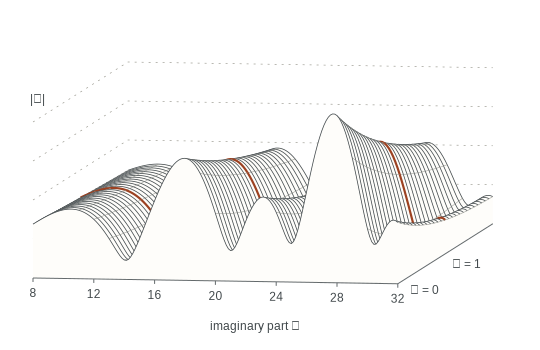
The frontispiece plots |ζ(σ+it)| on 27 equally spaced sections 0≤σ≤1. Each section contains 169 samples, 8≤t≤32. The copper section on this page has σ=½. The opening figure allows other sampled sections to be selected. Height is linear in |ζ|. Smoothly joined sample values can miss a zero between mesh points.
The generator sums the first 95 Dirichlet terms, then applies Euler–Maclaurin at N=96 through B₆. The absolute remainder is bounded by |s(s+1)⋯(s+5)| N−σ−5/[30240(σ+5)] from the periodic Bernoulli remainder. This is less than 0.000002 across the plotted domain. Binary64 evaluation adds rounding error. Euler–Maclaurin representation · Figure generator source